

 Posts
Posts



Friday, January 11, 2013
Smoking Point of Oils
Low Smoke Point vs High Smoke Point
Different cooking oils do react differently to heat, generally the higher they are heated, the more they break down and start to smoke. The temperature at which any particular oil will begin to smoke is called a smoke point. A high smoke point means that it can be heated to a higher temperature before it starts to smoke.
Vegetable oils tend to have higher smoke points than animal product based fats. However, refined oils, with more impurities removed results in an even higher smoke point. There are other factors involved as well, the longer the oil heats and begins to brake down the lower its smoke point becomes. So, fresh oil will have a higher smoke point than leftover used oil. The general rule of thumb is to discard the old oil after three uses.
In a commercial food service setting rarely is olive oil used for frying and I’ve never seen it used for deep frying. That is not to say that very good results can not be attained by sautéing using a product such as Avanti Savoia’s cooking olive oil. One of the overriding factors is not only the prospect of losing the very delicate and subtle organoleptic characteristics ( of fine extra virgin olive oil but, also the cost.
Health benefits … are not lost…
While we do recommend our Avanti Savoia cooking oil for sautéing we usually reserve our top quality olive oils for recipes such as pasta, salad dressings, dipping oils or adding fine extra virgin olive oil at the end of the cooking process such as drizzling on vegetables, fish, poultry or meats. The health benefits of extra virgin olive oil are not lost as long as the oil is not heated past its smoking point. But what is that point?
Finding reliable and accurate smoke point sources can be challenging as even the information provided by experts can vary widely in the exact temperatures at which a particular variety of oil will began to smoke. I began to research some material for this post with my “usual suspects” of technical references. Very quickly I came to appreciate the very different information given by a number of qualified experts. A bit of the conflicting data has been collected here for you to compare for yourself.
SMOKING POINT OF OILS
On Cooking – A Textbook of Culinary Fundamentals
Butter – 260 F
Lard - 370 F
Canola Oil – 430 F to 448 F
Extra Virgin Olive Oil – 250 F
Peanut Oil – 450 F
Shortening, vegetable – 410F
Soybean Oil – 495 F
The Professional Chef – Culinary Institute of America
“Generally, vegetable oils begin to smoke around 450 F, while animal fats begin to smoke around 375 F. Any additional materials in the fat (emulsifiers, preservatives, proteins, carbohydrates) lower the smoke point.”
On Food and Cooking – by Harold McGee
Butter – 250 F
Lard – 400 F
Vegetable oils – close to 450 F
Shortening, vegetable – 370 F
Food Lover’s Companion – by Sharon Tyler Herbst and Ron Herbst
Canola oil – 435 F
Olive oil – 410 F
Peanut oil – 450 F
Sesame Seed oil – F
Soybean oil – 450 F
About.com Culinary Arts
Butter, whole – 350 F
Butter, clarified – 450 F to 475 F
Canola oil – 425 F to 475 F
Lard – 375 F
Olive oil – 325 F to 375 F
Soybean oil – 450 F to 475 F
Wikipedia
Butter – 250 F – 300 F
Canola, refined – 400 F
Extra Virgin Olive Oil – 375 F
Lard – 370 F
Peanut oil, unrefined - 320 F
Peanut oil, refined – 450 F
Sesame oil, unrefined – 350 F
Sesame oil, semi refined – 450 F
Soy oil, unrefined – 320 F
Shortening, vegetable – 360 F
International Olive Oil Council (IOOC)
“When heated, olive oil is the most stable fat, which means it stands up well to high frying temperatures. Its high smoke point (410ºF or 210ºC) is well above the ideal temperature for frying food (356ºF or 180ºC). The digestibility of olive oil is not affected when it is heated, even when it is re-used several times for frying.”
It all sort of depends on who you believe and for a professional chef – there is nothing like a few decades of experience.
Happy frying!


Wednesday, November 21, 2012
THE GREAT AMERICAN THANKSGIVING

For the typical American just the words “Traditional
Thanksgiving Dinner” have the power to evoke a whole range of images and
catchwords. Whose tradition? What
dinner? And for that matter, why are we
giving thanks in this manner, anyway?
Americans love Thanksgiving and as we all know, celebrate it with family
reunions, gatherings of friends and sumptuous feasts. We also surround it with an enormous
collection of myths and questionable history.
As we enthusiastically observe our “great North American Holiday” note
that we were hardly the first civilization to set aside days of thanks. Greeks, Romans, Anglo-Saxons, Hebrews and
many other ancient cultures all celebrated in the autumn to give thanks for an
abundant harvest.
The event that we generally think of as the first
Thanksgiving was in 1621. It was a three
day English Harvest Festival celebrated by some 90-odd Wampanoag Native
Americans and about 60 of the surviving Pilgrims. We hold dearly to an enduring image of the
somberly dressed Pilgrims and their native guests enjoying a “traditional”
Thanksgiving menu. However the iconic Turkey
might not have adorned the groaning board, as the term was generically used to
indicate wild fowl which very well may have been duck or goose. No pumpkin pies or dinner rolls either, as
the colonist had long before exhausted their supplies of flour. Boiled pumpkin and fried cornmeal bread were
far more likely and it is recorded that the feasters enjoyed the fresh venison
from 5 deer contributed by Chief Massasoit and his countrymen. Their menu was further enhanced by lobster,
clams and other freshwater fish.
Berries, dried fruit and wild greens were probably enjoyed, as
well.
Even the day upon which we celebrate this event has gone
through considerable evolution. As
genuinely successful as this “first” Thanksgiving seems to have been, it was
not repeated the next year and was never observed by the Pilgrims on any
regular day. The establishment of the
national holiday on a regular annual basis was the result of a 1863
proclamation by President Abraham Lincoln which established our present holiday
on the last Thursday of November. We
have continued with this tradition ever since (mythic imagery and all) except
for a brief and unpopular switch to the third Thursday in November during FDR’s
administration.
People tend to be very opinionated and passionate about
their culinary preferences, although this has more to do with regional tastes
and individual family prejudices than with historical facts. As a youngster in Texas of the 1950s, I fondly remember my
father’s absolute contempt for all white bread “Yankee Dressing”. My grandmother’s sage and cornbread dressing
was and is the holy writ. However, in
both my home and career, I have discovered that it is not necessarily heresy to
recognize the melting pot nature of our American holiday. In this spirit we offer you our recipe for
Sweet Potato Mousse.
SWEET POTATO MOUSSE
A unique Southern dessert made
with Lowcountry Produce’s Sweet Potato Butter; a favorite at Avanti Savoia’s
annual Open House
Serves 8 to 10
Available at Avanti Savoia*
Ingredients:
·
12 ounces Whipped Cream Cheese
·
¼ cup Doug’s Other Honey*
·
One 16 ounce jar Lowcountry Produce Sweet Potato
Butter*
·
2 teaspoons Silver Cloud Vanilla Bean Paste*
·
½ teaspoon Avanti Savoia Allspice*
·
2 teaspoons Avanti Savoia Cinnamon*
·
!/2 teaspoon Nutmeg*
·
½ pint heavy cream
·
2 Tablespoons powdered sugar
Instructions:
1.
Bring cream cheese to room temp and whip in an electric
mixer until smooth.
2.
Add honey and mix well.
3.
Add Sweet Potato Butter and blend very well, scraping
down sides as necessary. Next, blend in
the vanilla and spices.
4.
In a separate mixing bowl, whip cream and powdered
sugar until fluffy. Fold this into the
mousse mixture.
5.
Place mousse into attractive serving bowl or individual
serving bowls. The mousse can also be
served in bite size pastry cups.
Refrigerate over night or for a least several hours.
6.
Serve with or without a dollop of whipped cream.
Wednesday, August 1, 2012
GOING MUSHROOMING
Always follow the 100% rule!
 |
| Chef Joseph and Dr. "Whitey" show off their bounty! |
We leave the open highway
We scatter, ranging through
The forest gloom; we ramble
Ankle-deep in dew.
Through thickets deep in dark
The spears of sunlight rush
On brown and yellow mushrooms
Under every bramble bush.
They hide among the stumps
Where birds alight to rest
And when we lose ourselves,
The shadows guide our quest.
So brief these autumn days
And sunset solitudes,
The twilight has no chance
To linger in the woods.
Our bags and baskets burst
With gathered stock before
We leave for home: pine mushrooms
Make almost half our store.
Behind our backs the dark
Still forest walls arise,
And, beautiful in death,
The day flames bright and dies.
Going Mushrooming
by Boris Pasternak
Baskets of Treasure
The famous author of Dr. Zhivago, Boris
Pasternak (like most of his fellow
Russians) was an avid wild mushroom hunter.
I found myself remembering his little poem about mushrooming recently
when I was engaged in the same pursuit. However,
my mushroom foray was located on the Tennessee
side of the Great
Smoky Mountain
National Park not the
Russian countryside. Other than the
poet’s mention of autumn and his harvest of Pine Mushrooms (Tricholoma matsutake), I was struck by
the similarities of the “rambles”.Our ramble was in very hot July and our baskets of treasure were the colorful Chicken of the Woods (Laetiporus sulphurus) and the highly sought after Chanterelle, actually two very similar species of Chanterelles (Cantharellus cibarius and Cantharellus lateritious).
 |
| A single Chanterelle |
Ashville Mushroom Club
And when I say “our”, I’m referring to a recent foray with the Asheville Mushroom Club. A quote from their website states “We are a diverse group of people whose common interest is to learn about and collect all kinds of fungi and to enjoy eating edible mushrooms we gather in the forest. Others cultivate fungi in their gardens. At our meetings, we hear from experts - many of them club members - about different aspects of fungi identification, folklore, cultivation and culinary preparation”.
Being with Dr. Harry “Whitey” Hitchcock is always an adventure
The host for the occasion and the source for my invitation
was Whitey Hitchcock. Oak Ridge resident
and Anderson County Commissioner Dr. Harry “Whitey” Hitchcock has been
studying, hunting, cooking and eating wild mushrooms for nearly 20 years. A
retired science teacher and avid naturalist, he currently forages seasonal wild
mushrooms and sells to restaurants as well as to individuals. Because finding
just the right mushroom is an opportunistic exercise, being with Dr. Whitey is
always an adventure – in the woods or in the kitchen.
“I see a lot of my friends in the woods”.
Dr. Whitey has an extensive background that has prepared him
for his wild mushroom expertise and reputation. Whitey’s father was a forester who inspired
his son to attend Forestry
School after a stint in
the service. Whitey actually put in 7
years as a Field Forester for TVA. The
master forager comments that “I love the woods; it was my refuge as a child and
part of who I am”. “I see a lot of my
friends in the woods”. I learned what he meant on our recent outing. He introduced me by name to so many of his
“friends”. Not just mushrooms but plant life of all kinds. I was especially drawn to the ferns and
mosses. Fern beds are a favored spot for
our very, very good friends – the Chanterelles (also Girolle in French,
Galletti in Italian and Pfifferling in German).
 |
| Chanterelles on the ground |
It is indeed a thrill
The Chanterelles are so beautiful and generally easy to spot; their bright
apricot color is highly visible against the green floor of the forest (once
your eye becomes used to their form). It is indeed a thrill when you find your
first one and then find another and another until your basket contains enough
for a feast! The “tie dyed” look of the
Chicken of the Woods and their preference for growing on logs and tree is also
easy to recognize |
| Chicken of the Woods on a log |
The beautiful Chanterelles and Chicken of the Woods that came home with me that day ended up being shared by the very lucky members of a Tuesday night cooking class at La Cucina. Although, the class itself was entitled “Cooking with Fresh Herbs and Spices”, we had planned to offer a recipe for marinated mushrooms as well as a dish of deep fried mushrooms, anyway. It turned out to be a perfect opportunity to use our newly harvested Chanterelles in the marinade as well as deep frying the Chicken of the Woods. What a nice “lagniappe” that was to share with our cooking students.
 |
| The platter for class |
When I asked Dr. Whitey to describe his level of wild mushroom expertise, he answered simply that he is “pretty competent in identifying the mushrooms of his region and that he knows how to figure out specimens from other regions”. He points out that he has never been sick from eating foraged mushrooms and that he always follows what I call the “100% rule”. That is the rule that states that you must be 100% sure of your identification noting as one of my earlier mushroom instructor pointed out “99% sure can kill you”.
A class that sells out very quickly
Looking ahead at the calendar; on Tuesday, September 11, Dr.“Whitey” will be our guest at La Cucina to offer his class entitled THE WILD MUSHROOM FORAGER. La Cucina at
Avanti Savoia is happy to welcome Whitey to share his expertise, harvest and
delectable recipes with us and our students.
The menu will include:
- Chicken of the Woods curry on rice
- Creamed Chanterelles with smoked ham over stone ground grits
- Leek, Potato and wild mushroom (as available) Gratin
- Special finds will be sautéed and served with eggs on toast points
- Dr. Whitey will be in the woods several days before the class.
Mushroom selection will depend on
weather and harvest. Visit our Cooking Class schedule for more information. We
expect this to be a class that sells out very quickly.
Learn at the side of a qualified expert
Learning to identify wild mushrooms is something that one
needs to learn at the side of a qualified expert. Reference books are useful as a reference but
not as a sole guide to identification.
Positive identification is not the only concern in harvesting wild
mushrooms either. Private property
should be the site of foraging only with clear permission from the owner.
“Tsiya’hi”
In the instance of harvesting on public land, make sure you
know and understand whatever regulations apply (and stick to them). My adventure with Dr Whitey and the Asheville
Mushroom Club took place in a particularly beautiful and historic spot known as
“Cades Cove’ located in the Smoky
Mountains, an area known
for its amazing plant and wildlife diversity.
Cades Cove is the single most visited spot in the most visited park in
the National Park system. The Cove is an
isolated valley that was home to early settlers as well as the Cherokees, who
called the place “Tsiya’hi” or “otter place”.
The otters have long since disappeared as well as permanent residency by
anyone.
The Park Rangers take their jobs… very seriously
Even as heavily visited as this area is, one can still find vast quiet copses full of wildlife and yes, yummy mushrooms. This extraordinary area is also a UNESCO World Heritage Site. So, therefore very special rules govern the entire park to help preserve it. The Park Rangers take their jobs as stewards of this park very seriously as Dr. Whitey and I noticed when US Park Ranger Jamie Sanders appeared on one of the shaded hillside that we were foraging. After making sure that we knew the regulations and were adhering to them, we enjoyed an interesting conversation with her and she invited the good doctor back to the Ranger Station for him to assist her with some plant identification. While we visiting, Ranger Jamie was helpful in providing me with the specific regulations concerning the collecting of mushrooms and other wild harvest.
 |
| Ranger Sanders holding Chicken of the Woods |
From the Superintendents Compendium:
“…certain mushrooms (edible species only) may be gathered by hand for personal use or consumption (commercial use is prohibited). The amount of fruits, berries, nuts and fruiting bodies of mushrooms that are authorized for collection shall not exceed 1 pound per person per day for each species, except for apples, pears and peaches. The gathering of designated fruits, fruits, berries, nuts and mushrooms is prohibited within 200 feet of nature trails, motor trails, handicapped accessible trails and scientific and nature study areas”.
Enjoy your wild mushroom foraging but, be informed, be safe and be responsible. Vivent les champignons sauvages et Bon Appetit Y’all.
Tuesday, June 12, 2012
SMOKED BOSTON BUTT AVANTI SAVOIA STYLE
Dry rub mixtures are the perfect way to prepare dishes for the long cooking process of slow smoking. They lend a deep savory flavor to smoked meats and as they are usually cooked over indirect heat, burning or scorching is not a problem. Dry rub mixtures can be made out of almost any ground spice or herb combinations. One of the BBQ lovin’ Southern favorite cuts of pork is Boston Butt. Boston Butt is generally the choice for the ever present pulled pork sandwiches so beloved in the south. To begin with, the name “Boston Butt” is more of an historical description than an anatomical one. The cut itself is the upper part of the shoulder from the front leg. It may also contain the blade bone. Before the American Revolution a great many pork products were processed in the city of Boston. They were then packed into barrels for shipment known as “butts” and two hundred years later we still use the term “Boston Butt” to describe this flavorful piece of pork.
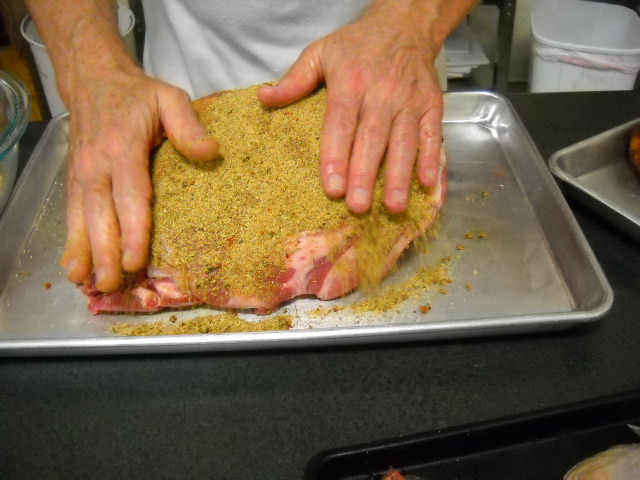 |
| Step 1: Hand rub with preferred dry rub |
Always carefully rinse the foods to be cooked and completely dry each piece. Do
this ahead of time and place the items uncovered into the refrigerator for at least an hour before you add the dry rub. Remove meat from the refrigerator and hand rub each piece with a small amount of Avanti Savoia All-Purpose Cooking Olive Oil and a generous application of dry rub. Use as much dry rub as will stick (about 1/3 cup for a 4 or 5 lb. Boston Butt pork roast. My preferred method is to rub in some of the seasoning with my hands and then sprinkle on some more.
Heart O’ Texas Dry Rub
- 2 Tablespoons ground Cumin
- 1 teaspoon Thyme
- 1 Tablespoon Oregano
- 2 Tablespoons granulated Garlic or powder (not garlic salt)
- 2 Tablespoons Onion Powder
- 2 Tablespoons Chili Powder
- 1 Tablespoon (crushed) Juniper Berries
- 2 teaspoons Ground Black Pepper
- 1 Tablespoon Salish (Alder wood) Smoked Salt
 |
| Step 2: Prepare you coal then add your choice of wood |
The Fire
This depends entirely upon what equipment and system you are using, but the best smoking is always done over indirect heat. This can even be done on a very simple kettle type charcoal grill by simply arranging the charcoal in a ring around the edge of the grill. Like a doughnut with no charcoal in the middle over which the meat or whatever will cook. Amounts of charcoal will vary according to the size or amount of items to be smoked. Do not scrimp on the charcoal because you do not want the fire to go out before you have finished the smoking process, a little experience will help you to make the right call. Light your fire according to your custom (lighter fluid or however) and allow it ignite to a full glow. Make sure the meat rack is clean and hot before you begin cooking. Nothing ruins grilled or smoke meats for me quite as much as the burnt bitter flavor from a less than clean grilling rack.
Wood Chips for Smoking.
Packages of Hickory or Mesquite chips/chunks are available wherever grilling supplies are sold. Good enough, but there are many other choices that may be available out of your own backyard or at least your own area. Almost any wood from fruit tree pruning will work well, instilling its own subtle character and flavor. We have had great luck with wood chips from apple, pear, peach, plum, nectarine as well as terrific results from wild cherry trees that grow abundantly in our locale. Wood from nut trees is really nice too, especially walnut and pecan. I find that pieces of wood about 3 or 4 times the size of my thumb work best. Sometimes I soak them in water first and sometimes I use them dry, both methods work just fine but, I think I prefer using the chips dry. I find however that a water pan under the meat rack is very important in producing a nice moist meat. You can also use many different kinds of liquid in the “water” pan besides water (wine, beer, mint tea, soda pop that has gone flat, left over brine from pickle jars adds nice flavor too). The wood chips or pieces are added after all the coals are glowing and just before adding the meat.
Smoking and Serving
 |
| Step 3: Fill the "water" pan with your choice of liquid |
 |
| Step 4: Let the smoking begin! |
Pop Lowery’s Texas Lemon Barbecue Sauce
Yield: About 4 Cups
- Grated and finely chopped peel and juice of 1 lemon
- 2 Tablespoons of yellow onion, finely chopped
- 12 ounce bottle of Chili sauce
- 2 Tablespoons Worcestershire sauce
- 2 Tablespoons brown sugar
- ¼ cup prepared yellow mustard
- 2 teaspoons Ground Black Pepper
- 1 teaspoon Chili powder
- 1 teaspoon granulated Garlic or powder (not garlic salt)
- ½ tsp. Tabasco sauce
- 2 tsp. Sel Gris Sea Salt
- ¼ cup All-Purpose Cooking Olive Oil
 |
| Lookin Good! |
Father’s Day Menu 2012
 |
| Step 5: Quickly get inside before your neighbors know it's ready! |
Appetizer
Main
Smoked Boston Butt (above)
Sides
Dessert
Jolly Blue Giant Blueberry Pie (below)
Jolly Blue Giant Blueberry Pie
This two crust pie will require the dough recipe to be doubled.
Pie Crust Dough
Ingredients:
- 2 cups all purpose flour, sifted
- ¼ cup butter
- ¼ cup shortening
- 4-5 Tablespoons ice water
- Combine flour and butter in food processor and mix for short time. Add shortening and blend again.
- With the food processor running add ice water a tablespoon at a time until the dough forms a ball. Remove from machine, cover and let rest in the refrigerator until ready to roll out and fill.
Ingredients:
- 6 heaping cups fresh blueberries
- 1 to 1 1/4 cups sugar (depends on sweetness of berries)
- 3 Tablespoons cornstarch
- 1 Tablespoon flour
- Pinch of salt
- 1 Tablespoon Water
- ½ teaspoon cinnamon*
- ½ teaspoon Silver Cloud Vanilla Bean Paste*
- 2 teaspoon Silver Cloud Blueberry, Natural Flavor*
- 1/2 of a 9 ounce jar of Lowcountry Produce Blueberry Preserves*
Instructions:
- Combine blueberries, sugar cornstarch, flour, salt and cinnamon in a large saucepan and cook for about 5 minutes, stirring often and gently. Remove from heat; fold in Vanilla, Blueberry flavor and preserves. Allow to cool.
- When filling has cooled; roll out bottom crust, fit into pie pan and add filling.
- Roll out top crust and top pie carefully sealing edges or form a lattice top. Brush with a beaten egg and sprinkle with a little more sugar if desired.
- Place pie into a 425 degree oven and cook for about 20 minutes. Reduce heat to 350 and cook for another 30 to 35 minutes. Remove from oven and allow the pie to set a little while before serving.
Friday, May 4, 2012
2012 DOGWOOD ARTS FESTIVAL
52 Years of Celebrating
Despite the terrible press
In the year 1947, a famous travel writer called Knoxville, Tennessee “the ugliest place I ever saw in America.” Still smarting from such an insulting description, the Chamber of Commerce in 1955 organized an auto tour in some of Knoxville’s most elegant neighborhoods. The idea was to view the area’s beautiful spring flowers, especially the gorgeous Dogwood blossoms. In 1961 the event grew into a real downtown festival with special events, food and music illustrating to the world that our community had vision, that we were creative, we were progressive and we were beautiful (despite the terrible press).
Radio personality Paul Harvey
Many celebrity guests have enjoyed the festival over the years but few expressed their delight as eloquently as did radio personality Paul Harvey in his 1996 Commentary on the Dogwood Arts Festival. “There’s something about the soul and the climate between the placid lakes and the sloping meadows and the stone bluffs of the Smokies. There’s something about Knoxville that makes dogwood trees grow taller. Blossoms are giant-sized. Pink hybrids are a translucent pink. On shady slopes you’ll see wild dogwood branches creating a fountain from the top of a limbless trunk, and then drooping gracefully down in a waterfall of white blossoms. And in residential streets, the nurtured dogwoods are resplendent by day and moonlighted by night.”
Grand garden party
“It was their Dogwood Arts Festival I attended in early April. Over 35 years, that Festival has grown to where it hosts a quarter-million visitors for its grand garden party. There are violets and iris, many apples carpeting the woodland floors, May apples. There are lilacs and narcissus, and a rainbow of flowering fruit trees, but mostly along half a hundred miles of trails, into and through and around the city is a springtime blizzard of blossoms of dogwood.”
The natural beauty of our region
In 1978 The House and Garden Show was established, followed by A Very Special Arts Show in 1979 and Bazillion Blooms, the Chalk Walk, and Rhythm N' Blooms in 2009. Fast forward to 2012 and “Dogwood Arts is now a widely respected not-for-profit organization whose mission is to support arts, education, promote the visual and performing arts, and to preserve and enhance the natural beauty of our region.” 2012 celebrates the 52nd anniversary of the Dogwood Arts Festival and 58th anniversary of the Dogwood Trails. The 2012 Festival also marked the inauguration of a new feature, the Culinary Arts Stage.
10 different demonstrations
The Culinary Arts Stage at Market Square Art Fair was situated at the edge of Krutch Park under a canopy of beautiful trees. Thousands of visitors strolled through the Art Fair over the three day weekend and many of them visited the free admission Culinary Stage. The culinary event offered ten different demonstrations and tastings by five chefs and culinary professionals and required the chefs to prepare 120 portions of their dish for sampling that was separate from their actual demonstration food.
“Elevate life with every glass raised”
Constellations Wines and local wholesaler Triple C Distributor offered a daily tasting of five different Robert Mondavi Wines as well as matching wine with each demonstration. Darrell Freeze, Field Sales Manager for Constellations Wines presented a program that included Cabernet Sauvignon, Merlot, Pinot Noir, Fume Blanc, and Chardonnay. Darrell stressed that his company is actively engaged in “balancing the art and business of making wine”. He also encouraged tasters to “elevate life with every glass raised”. The wine tastings were indeed very well attended and made more enjoyable with the battery of real glassware provided by All Occasion Rental.
Sequoyah Grille
The first dish of the event was Risotto Italiano prepared by Chef Kirk Emory of Knoxville’s Sequoyah Grille Restaurant. The concept behind the Sequoyah Grille is to utilize the freshest seasonal ingredients available, using classic culinary techniques and presenting the dishes with creative, artistic flair. Chef Emory described their restaurant as a “neighborhood grille” and their cuisine as “right out of the ground fresh”. The chef’s wife, Amy is also the business’ General Manager as well as the restaurants wine expert.
Nori Modern Noodle & Sushi Bar
Vietnamese/Thai fusion cuisine was represented by another local restaurant, Nori Modern Noodle & Sushi Bar. The restaurant’s Sushi Chef, Justin Holleman demonstrated Vietnamese Shrimp and Basil Rice Paper Rolls as well as California Rolls. The chef also noted that his restaurant prides itself on fresh vegetables and herbs and especially their freshly made home style broths.
Tupelo Honey Cafe
Asheville, North Carolina’s popular Tupelo Honey Café was in charge of the next presentation. Tupelo Honey Café currently has two locations in the Asheville area but will be expanding to Knoxville later this summer where they will be serving breakfast, lunch and dinner. Chef Brian Sonoskos attributes their success to “a great following and a passionate staff”. Their goal is “to provide a fine dinning experience at everyday low prices.” New Pimento Cheese is a trademark of the restaurant (they even have a Pimento Cheese of the Month Club) and was the dish that the chef chose for his demonstration. Chef Sonoskos and the Café have just published their first cookbook, Tupelo Honey Café: Spirited Recipes from Asheville’s New South Kitchen
Cake of Knoxville
Heather Grubb is a stay at home mom with two young daughters and the owner of a small business – Cake of Knoxville and the veteran of 8 episodes of The Learning Channel’s reality competition, Next Great Baker. She was also an entertaining demonstrator on our Culinary Stage. Heather regaled the audience with her behind the scenes stories of a TV reality show while whipping up a batch of her Lemon Yogurt Cupcakes. The audience was charmed as much by her effusive personality as by her tangy cupcakes.
Avanti Savoia Imports
Avanti Savoia was represented by our culinary team of Chefs Joseph Lowery and Karen Crumley. Our offering was a dish that we have had great success with each time that we have served it; Radiatore Pasta con Salsa Fresca. It is an easy and quick dish to prepare, although one that is always full of flavor. Simply put, it is hot pasta served with an uncooked sauce of fresh vegetables, herbs and feta cheese served with a tangy dressing of extra virgin olive oil and balsamic vinegar. Essentially a “warm” pasta salad, the key is good produce and (of course) the best oil and vinegar. We’ve printed the recipe below for your convenience.
Blogger Alan Sims
One of the nicer compliments that we received was from blogger Alan Sims. He tells us that he enjoyed the dish so much that he visited Avanti Savoia’s booth and purchased the necessary ingredients so as to be able to recreate the dish for his own Sunday dinner. Check out Alan’s blog and pictures covering the festival. This blogger also writes about the Chalk Walk with lots of fantastic pictures on the same site.
Complicated and challenging
Besides our cooking demonstration we also had the privilege of sharing the 3 day hosting duties with our good friend and preeminent food stylist, Linda Ullian Schmid. The logistical organization (complicated and challenging) was handled brilliantly by Chris Kahn, which meant that she not only spent untold hours planning the event but also working hard in the trenches doing everything from clearing tables to pouring wine.
Presenting sponsor
Avanti Savoia is an enthusiastic believer in the mission of the Dogwood Arts Festival and we had the distinction of being the Presenting Sponsor of both the Culinary Stage and the Chalk Walk. No event of this magnitude happens without the efforts of an army of volunteers and we sincerely thank each and everyone who helped especially the staff of The Dogwoods Arts Festival and the Culinary Stage committee. A very special thank you to Publix, the event’s sponsor. The appliances were provided by Quinn Appliances and Viking. Acme Block and Brick built our magnificent outdoor kitchen set and Regions Bank gave up their parking lot for our event tent.
50,000 people
An estimated 50,000 people visited downtown Knoxville that sunny beautiful weekend and we think a good many of them left as our friends. As this was the festival’s first year offering the Culinary and Wine Stage we all learned a lot and all we can really say is – “just wait until next year and Bon Appetit Y’all”!
Tuesday, February 14, 2012
Balsamico Tradizionale

The words Aceto Balsamico Tradizionale roll off my tongue fairly readily these days, but it was not always so. Sometimes, when something has become very familiar in one’s life, it’s easy to forget the time that it was not always so familiar. That would be the case for me with Balsamic Vinegar.
Man on the ground in Italy…
Not the case for Don Vito de Carolis, Avanti Savoia’s intrepid man on the ground in Italy. Vito personally knows the producers and carefully selects the Italian products marketed by Avanti Savoia. Although Vito has upgraded and expanded my knowledge of Italy’s “liquid gold”, my introduction to it was over 30 years ago.
Drop by drop…
My first bottle was a gift from Chef Deborah Madison, founding chef at the San Francisco restaurant, Greens in historic Ft. Mason. Greens Restaurant is operated under the auspices of the San Francisco Zen Center and is one of our country’s premier vegetarian restaurants. I carefully brought my treasure home and discovered its pleasure by doling it out drop by drop.
Buyers beware…
Now we see “balsamic vinaigrettes” on fast food menus as well as a range of questionable products lined up on the grocery store shelves. BUYERS BEWARE… there is plenty of fake balsamic vinegar on the market. Many of these vinegars have only their name thing in common with the real thing. Currently, anyone anywhere can legally produce “Balsamic Vinegar of Modena”. They can range from very sweet to pungent and savory. The better quality (and more expensive) are aged at least three years while the “cheapies” are aged only a short time in stainless steel tanks and artificially sweetened and thickened. “Aceto Balsamico di Modena” (Balsamic Vinegar of Modena), is not the same as “Aceto Balsamico Tradizionale” (Traditional Balsamic Vinegar).
Confident of the authenticity…
At Avanti Savoia, we take balsamic vinegars seriously and we are very confident of the authenticity of our entire line. REAL Balsamic Vinegars—the unique and noble “Gold Standard” of Italy—are produced only in the regions of Modena and Reggio Emilia. It has only been during the last few decades that American cooks have discovered balsamic vinegar and elevated it to “rock star” status in the culinary world. In Italy, balsamic vinegar has been prized for centuries. In medieval times, it was valued for its healing properties. For a thousand years, wealthy Italian families have produced balsamic vinegar for their own use.
Royalty and only the most fortunate guests...
Fine aged balsamic vinegars were considered treasured family heirlooms, often as part of a bride’s dowry. Considered “liquid gold,” small kegs of balsamic vinegar could be slowly consumed or even sold if economic conditions warranted. On special occasions, royalty and only the most fortunate guests might receive balsamic vinegar as a gift.
A select group of hoteliers...
At a recent event in Phoenix, Arizona, Avanti Savoia had the opportunity to showcase some of our more impressive balsamics at a tasting for a select group of hoteliers. Our invitation came from one of Phoenix’s premier caterers, Creative Hands Cuisine.
Sound familiar…
Owner and Executive Chef Doug Brochu and his wife/partner Camille Brochu describe their fare as “contemporary American Cuisine paired with a Mediterranean flair”. Sound familiar? The same concept could definitely be used to describe our attitude at Avanti Savoia.
The city of Phoenix’s “Point of Pride”…
The caterers provided really top notch fare at the location of the event, which was an elegant home perched on the side of Camelback Mountain, the city of Phoenix’s “Point of Pride”. The view of the sunset over the skyline of Phoenix was a stunning backdrop for a stunning event.
Our stellar products…
Avanti Savoia provided a Balsamic tasting bar with four of our stellar products. Included in this lineup were the following:
Acetaia Palatrini (Modena) Extra Vecchio 50 years
Giuseppe Giusti (Modena) Extra Vecchio 25 years
IL Borgo Gold (Reggio-Emilia) (Gold Corresponds to Extra Vecchio) 25 years
Giuseppe Giusti (Modena) Gold Medal Traditional 12 years
See our entire line of fine Balsamic.
Two of our most popular olive oils…
We also enhanced the tasting by including two of our most popular extra virgin olive oils; Paolo Cassini S’ciappau Gran Cru produced from the Taggiasca olive from the Linguria region of Northwest Italy and an organic oil, Marcinase pressed from the Coratina olive in the the Puglia region, the “boot heel” of Italy.
Several options…
The caterer provided a spread of delights to compliment our tasting including artisan breads, grapes, strawberries, chocolate, ice cream and a luscious platter of fine cheeses. We suggested several options to the guests for their tasting progression. For those interested in a serious comparative experience the plan was simply to taste the balsamics in the order of their ages.
The classic Italian manner of tasting…
That was accomplished by small amounts in demitasse spoons or in the classic Italian manner of tasting a small drop directly from the back of the hand. There were also those guests that wanted to sample different balsamics with the different foods. As is always the case with balsamic tastings, it was great fun to introduce the uninitiated to the joys of combining fine balsamic vinegar with strawberries or ice cream. The consensus favorite had to be the Giuseppe Giusti Extra Vecchio. This 25 year old beauty amazed us all with its deep round flavors full of delicate nuances. For much more information on Giuseppe Giusti and all things balsamic, read our post A Vinegar Primer.
Salt Maestro…
We also had an excellent time with the Salt Maestro, Mark Bitterman. Mark had also been invited to the event to share his love of gourmet salts and of course, there was much discussion between the two of us. Try Mark’s suggestion of a tiny pinch of fine salt on a strawberry drizzled with a 50 year Balsamic. WOW! Mark is the author of the amazingly beautiful new book, SALTED. For more info visit his website, www.the meadow.net
Thank you to Sara…
A last word about the staff of Creative Hands Cuisine – perfection; organized, skilled and focused. It was a pleasure to be their guest and I must offer a truly genuine thank you to Sara, my hard working attendant; she made a special evening infinitely more pleasant!
Viva Aceto Balsamico Tradizionale!
Thursday, December 15, 2011
Fresh Black Truffles… from East Tennessee?

To the uninitiated, they are not much to look at; uneven, wrinkled, black lumps ranging in size from peas to tennis balls. But, to serious foodies and chefs alike these black lumps reside at the pinnacle of culinary legend. They are not particularly attractive to describe either; “the fruiting body of an underground fungus that grows in symbiosis with some varieties of oaks and hazelnut trees; parasites actually that grow near the roots of the trees”.
Tuber melanosporum…
However, this subject of mysterious folklore, gastronomic mystique and powerful passions is of course, Tuber melanosporum. The rare and sublime aroma, the pungent, unmistakable and yet hard to describe flavor; we could only be talking here about one thing – the world’s most delectable and luxurious “fungus” - fresh Black Truffles – the glory of France! Wait, did I say France? I actually meant the glory of East Tennessee! Yes, in the foothills of the beautiful Appalachian Mountains, an extraordinary harvest and agricultural dream is well underway.

At Avanti Savoia, we have always deeply appreciated culinary treasures from family owned farms and small producers that represent patience, skill and a deep respect for land, culture, and, above all, taste. We are incredibly excited to announce the amazing efforts of our (all of the above) neighbor, Tom Leonard of Leonard’s Truffiere. Although, the elusive fungus has long evaded cultivation, Tom grows truffles! Not chocolate candy, but real truffles right here in the USA!
His true destiny…
After over a decade of persistence and vision, Tom’s dream is paying off and you are the lucky winner! Tom is a farmer by his family heritage and a Registered Nurse by occupation. But we predict that it is as one of America’s first truffle farmers that he will realize his true destiny. Tom owns land in the Eastern part of the state of Tennessee (and no we’re not telling exactly where; dastardly truffle robbers, you know?). In time he realized that his farm has soil or terroir and other conditions similar to the truffle growing Perigord region of France.

That was just the beginning; he then needed to condition his soil and plant his hazelnut trees inoculated with the spores of Tuber melanosporum. Although in the past, the French often employed pigs to find the elusive fungus, that job is now mostly accomplished by dogs, some especially bred for the right traits. Tom needed a truffle dog. In a wonderful story for animal lovers, Tom found his dog at an animal shelter. “Bonnie” was as Tom puts it “only a few moments away from the needle.” Perhaps in appreciation “Bonnie” has turned into a truffle dog extraordinaire! Tom’s glad, Bonnie’s glad and so are we!
“Black Diamonds”…
For a limited time only, while the weather cooperates and the harvest continues, Tom Leonard’s fresh, gorgeous truffles are available directly to you through Avanti Savoia. Do not miss this opportunity to experience first hand, these freshly harvested “Black Diamonds”; one of the world’s most distinctive culinary treasures. Click here to go now.
Fresh truffles are best served, well… fresh.
It is reported that there are at least 100 varieties of truffles but, there are only a few that are used in cooking. Fresh truffles are best served, well… fresh. Frozen, canned or fresh can be used somewhat interchangeably, but it is when they are very fresh that they best exhibit both their distinctive flavor and texture. Fresh truffles can be wrapped in paper towels, placed in an air tight container and stored in the refrigerator for up to 5 days. Fresh truffles also freeze well, but the texture changes as the little white veins turn to liquid.
Natural parings with the distinctive truffle...
A little can go a long way as well. It is also important how they are prepared and with what dishes. Foods like rice, risottos, pastas, polenta, potatoes, cheese, cream and eggs are all natural parings with the distinctive truffle. Butter, oil and other fats also help showcase the intriguing flavor. The truffles can help intensify other flavors, but recipes with too many strong flavors would just complicate and perhaps overwhelm what should be the star, i.e. the truffle itself. Generally speaking, about ¼ ounce per serving constitutes a generous portion.
Many chefs prefer to remove the outer skin…
Truffles are best served at their peak of freshness and not really cooked, but rather added to other dishes while they are hot, such as adding shaved truffles to a pasta table side or stirring into egg dishes at the last minute. Many chefs prefer to remove the outer skin or peridium and then slice the truffle into a fine julienne or matchstick pieces. The outer peelings can be chopped and then added to fine sea salt or used to infuse olive oil.
Chef Karen received the nod…
One of the great perks in working at Avanti Savoia is the opportunity to test and sample so many fine gourmet products. So, just a few days ago that meant experimenting with Tom’s fresh truffles. Chef Karen Crumley received the nod as truffle chef, meaning Ben and Chef Joseph got to be the tasters, lucky us. Chef Karen is a graduate of the University of Tennessee Culinary Institute, assists Chef Joseph with classes and teaches her own popular Sushi classes at La Cucina.
Most luxurious of ingredients...
The chef choose to demonstrate 3 dishes to sample this most luxurious of ingredients. First, a serving of toast points topped with a bit of sheep’s milk cheese, a quail egg fried in olive oil and topped with shaved truffle. Next, spinach salad with carrots, pears, some Pecorino/ Romano cheese, truffle slices and dressed with just a little Cassini extra virgin olive oil and Il Borgo Tinello vinegar. Then, per Chef Joseph’s request; smashed, “dirty” baby Yukon potatoes enriched with cream, butter, olive oil, Black Truffle salt, crispy pancetta pieces and yes, more shaved truffles. I bet you wish that you worked here too, don’t you?
Prepare your own fresh truffle dishes…
The next best thing is the opportunity to prepare your own fresh truffle dishes. For a limited time only, while the weather cooperates and the harvest continues, Tom Leonard’s fresh, gorgeous truffles are available directly to you through Avanti Savoia. Do not miss this opportunity to experience first hand, these freshly harvested “Black Diamonds”; one of the world’s most distinctive culinary treasures. Shop Now!
Subscribe to:
Posts (Atom)
