

 Posts
Posts



October was National Chili Month
…the bedrock of Tex-Mex cooking
As I write this post, I am deeply contemplating the phenomenon that is Chili. I can’t help but wonder if there is any other dish that inspires such devotion and enthusiasm and yet provokes such controversy and debate? I’m not about to claim any sense of objectivity or neutrality here. After all, I am a natural born Texan and I do appreciate the gravity of that responsibility! If there is one item to point to as the bedrock of Tex-Mex cooking, it is Chili.
…proof of the true origin
Chili as we know it, undoubtedly originated in the experience of the Southwestern cowboy/vaquero culture. It was traditionally a stew of chili peppers, spices and beef or whatever meat was available. There is also a longstanding tradition of Chili being cooked and sold on the streets of early San Antonio by the “Chili Queens”, but proof of the true origin is hard to come by.
…one of the more important issues in the free world
Not only is there little agreement as to the origins of the dish, there is absolutely no universal definition of Chili even within the Lone Star State itself. The truth is that most Texans consider the Chili that they grew up eating to be true Texas Chili. I think that this is probably true for just about everyone regardless of their region of the country or their style of chili. In an endless argument about what is “real” Texas Chili almost everyone has their opinion: add tomatoes or not, thicken with flour, Masa or nothing, the cut of the Chili meat, types of chili peppers, mix of spices and seasonings, beef stock water or beer and of course, one of the more important issues in the free world…beans or no beans. Did I mention that I am available for a cabinet level appointment as Chili Czar?
“Each of us knows that his chili is light-years beyond other chili…”
To quote a famous Chili man, H. Allen Smith, “That is the way of Chili men. Each of us knows that his chili is light-years beyond other chili in quantity and singularity; each of us knows that all other Chili is such vile slop that a coyote would turn his back on it.” What makes this statement especially hilarious to me is the fact that it is just the way I feel. I really do think that my version of Texas Chili is the best that I have ever tasted. Apparently, I have a lot of company; everyone seems to think that their chili is the best.
…some aberration from the city of Cincinnati
There is not even agreement in my own castle, as I married a girl from Ohio who has her own ideas about the meaning of Chili. First of all she insists on kidney beans in her Chili and then rambles on about some aberration from the city of Cincinnati served on top of spaghetti and then layered with a bunch of other stuff. In my horror I retreat to a statement from the 36th President of these United States, Lyndon Baines Johnson, “Chili concocted outside of Texas is usually a weak, apologetic imitation of the real thing. One of the first things I do when I get home to Texas is to have a bowl of Red. There is simply nothing better!”
“No talking to imaginary people”
I have to admit that one of the first things that I do after arriving in the city of Austin is to make a beeline to The Texas Chili Parlor for exactly the same reason. This hole in the wall restaurant has been an Austin institution since 1976. Located just a short distance from the state capitol and the University of Texas campus it is still a haven of funky atmosphere and local color. Now, here is a proper bowl of chili, made with chunks of beef, tomatoes and seasoning. Crackers, chopped onion, grated cheese and jalapenos are served on the side and of course, no beans. How could you go wrong in a place whose rules include “No talking to imaginary people?”
…thousands of chili recipes
Check the internet and you can find literally hundreds if not thousands of Chili recipes (or at least they claim to be Chili recipes). Vegetarian Chili, White Chili, Black bean Chili, Peggy Goldwater’s Arizona Chili, New Orleans Style (served over rice), and Cincinnati Style (we won’t go into that again). There is even a Tennessee dish that is a survivor of the 1982 World’s Fair in Knoxville named Petros, which is a layered creation of corn chips, chili, cheese, green onion, tomato, black olives and sour cream. Except for the black olive part I actually like Petros quite a bit, they remind me of a dish (not quite so complicated) that my Mother used to make back in the 1950’s called a Frito Pie.
…deer meat by itself and beef in my chili
I am part of a Texas clan descended from Choctaw ancestry and hunting was a huge part of our family’s culture. Therefore, I had the opportunity to sample Venison (deer meat) Chili many times, although I actually prefer my deer meat by itself and beef in my Chili. I also enjoy making Chili Verde New Mexico Style, which although it is muy delicioso in my book, it is not classical Chili, but rather chunks of pork stewed with green chilies, onions, tomatillos and herbs and spices.
Although, I never had the opportunity to share a bowl of Chili with President Johnson, I do have his favorite homemade Chili recipe.
Pedernales River Chili
(Pronounced Per-duh-now-lees by Central Texans)
4 lbs. chili meat (coarsely ground round steak or well trimmed chuck)
1 large onion
2 cloves garlic
1 tsp. ground oregano
1 tsp. cumin seed
6 tsp. chili powder (more if needed)
2 cans tomatoes with green chilies
Salt to taste
2 cups of hot water
Put chili meat, onion and garlic in large heavy boiler or skillet. Sear until light-colored. Add oregano, chili powder, tomatoes and hot water. Bring to a boil, lower heat and simmer about one hour. As fat cooks out, skim.
... the recipe sounded really tasty, but…
Well now, I wouldn’t want you to get the idea that the high art of Chili making is a partisan issue, even though tons of the stuff has been served at political gatherings at least since Texas entered the union. It was my intention to post a recipe for the Bush Families’ favorite chili, but I simply couldn’t find a specific recipe for their favorite. I did find a recipe in White House Chef cookbook by Chef Walter Scheib. Chef Scheib served as chef for both the Clintons and the G. W. Bushes. The chef’s recipe is called Three-Bean Chili and at the request of Mrs. Bush, contained no meat. I admit that the recipe sounded really tasty, but I’m simply not willing to recognize it as real Texas Chili.
“I absolutely swear to you that this is true!”
So, I went back to the Reagan years and found this recipe right away. The only real argument that I would have with the “great debater” would be the red wine (well, he was from California), the beef base (nasty, awful, salty junk) and the beans (at least they used pinto beans). I never had the chance to share chili with President Reagan either, although I did once enjoy a Martini with him! I absolutely swear to you that this is true!
President Reagan’s Favorite Homemade Chili
Serves 16
½ cup bacon drippings
2 cups chopped onions
4 chopped garlic cloves
2 pounds coarsely ground beef
4 cups canned whole tomatoes, chopped
1 bay leaf
1 Tablespoon salt
4 cups cooked pinto beans
Directions:
Using a 1 ½ gallon pot, melt bacon drippings. When hot, sauté onions and garlic cloves. Add ground beef and chili powder. Stir until meat is well browned. Add red wine (optional). Add salt, beef base, tomatoes, bay leaf and sugar. Simmer chili meat, covered, for 20 minutes, stirring often. Add pinto beans to the meat. Simmer chili for 1 hour, covered over low heat, stirring gently from time to time. Test for flavor.
…my definitive recipe
So… I doubt that anyone really follows a recipe to the letter. I know that I seldom measure the ingredients (unless it is for publication) and each batch of chili is slightly different. Keeping that in mind, here is my definitive recipe for some mighty good chili.
Chef Joseph’s Texas Chili
Ingredients:
1 Tablespoon olive oil
2 ½ lbs. coarsely cut ground beef (the coarser the better)
2 green peppers, chopped
2 white onions, chopped
6 cloves garlic, minced and mashed
¼ cup Masa (corn flour)
One 12 oz. bottle of beer (room temperature)
3 or 4 Jalapeno peppers, minced (or to taste)
1 28 oz. can of stewed tomatoes
1 Tablespoon Oregano
2 Tablespoons Ground Cumin
2 Tablespoons chili powder
1 Tablespoon Sage
1 Tablespoon Ground Black Pepper
1 Tablespoon Smoked Salt
2 Tablespoon parsley, chopped
2 teaspoons Red Wine Vinegar
2 teaspoons sugar
3 1/2 cups beef stock
Directions:
(1) In a large soup pan, heat olive oil and brown meat in batches and set aside. Add chopped peppers, onions and garlic to hot grease and cook 4 or 5 minutes.
(2) Add Masa and cook over a low heat for another five minutes, stirring often- it will stick!
(3) Add beer, minced Jalapenos, and tomatoes; bring to a simmer and stir in the browned meat.
(4) Continue simmering and add the rest of the ingredients. Cook a low simmer for two hours, stirring often. Do not let the chili stick or scorch!
(5) Taste for seasoning and serve with crackers, chopped onions and grated cheddar cheese. If desired serve a pot of pinto beans on the side, but NEVER add beans to Texas Chili.
…the pride, honor and glory of the Republic
Texans are fanatics about their chili (which is as it should be). The elements that contribute to the authenticity of this recipe are the following: Coarsely cut beef, Masa (corn flour), Jalapeno peppers, cumin and chili powder and no beans. Undoubtedly, there are a few (misguided) purists that will object to several of my ingredients (green peppers, tomatoes, mixture of herbs?), but I say let them share their complaints and inferior chili recipes with the coyotes! The truth is that I’ve tasted a whole bunch of awfully good chili concoctions in my day. However, the fun of the argument eternal about what is real chili is just too much fun to resist. Never do I forget that when I make Texas Chili; the pride, honor and glory of the Republic rest squarely on this old cook’s shoulders!
Beans on the side, Damn it!
Showing posts with label chef Joseph. Show all posts
Showing posts with label chef Joseph. Show all posts
Wednesday, November 11, 2009


Thursday, August 6, 2009
Pilgrimage to the Blue Ridge; a Promise Kept

“…Remembering speechlessly we seek the great forgotten language, the lost lane-end into heaven, a stone, a leaf, an unfound door.”
- Thomas Wolfe
I’m not a native son of the southern mountains although I am an enthusiastic adoptee. A huge part of the area’s attraction for me (and everyone else) is the magnificent mountains, ridges and foothills. In my younger (and slimmer) days, I seemed to find plenty of time to hike, camp, fly fish and generally spend quality recreational time in the Great Smoky Mountains National Park, National Forests, state and county parks. Along the borders shared by Tennessee, Georgia and North Carolina, there are some absolute paradises for outdoor enthusiasts.
“getting away”
Now, for the last 14 years or so, my wife, Gail and I have owned a few acres with some beautiful features. Sometimes, when we plan getaways and we have found ourselves noting that many of the enticements offered are already available to us. Privacy, quaint cottage, wood burning fireplace, babbling brook, and winding trail through the woods; really everything but a mountain view is literally in our own back yard. I have written about this before, but not for one minute do we forget that we are indeed blessed. Still, there is something about “getting away” and even just strolling a little in a beautiful setting.
...one of the last remaining virgin forests
Recently, upon a return trip from Atlanta, I found myself with an extra day in which to wander along some remote roads in northern Georgia and North Carolina. This included the magnificent Cherohala Skyway, which stretches some 40 miles from Tellico Plains, TN to Robbinsville, N.C. Near Robbinsville, one can find the Joyce Kilmer Memorial Forest. A moderately strenuous walk will bring hikers to one of the last remaining virgin old-growth hard wood forests left in the southern mountains. These giant trees over 400 years old surely must inspire some kind of poetic descriptions in even the most un-literary of observers.
…the luxury of time

Many other trails and quite walkways abound and most have few visitors. Being as I had the luxury of time (which I rarely allow myself), I took advantage of the lovely weather and just walked. When described it sounds very simple; trees, birds, cascades of musical water; just quietly experienced. With that quietness, I found myself trying to remember the last time I had spent much time on a mountain trail, much less on one by myself. Ten years? However long it has been is way to long, and I solemnly promised myself that at least every couple of months that I would fit in a day or two in the wilderness, just to experience a little solitude.
…one of the most scenic roads in America
So, about 2 months later, I made good on that promise with a brief trip to Asheville, NC and a leisurely ride up the Blue Ridge Parkway. In the state of North Carolina alone, the Parkway includes 469 miles of almost indescribable beauty. The Blue Ridge Parkway meanders along the crests and ridges of the southern Appalachian Mountains through four National Forests. This gorgeous drive ranks as one of the most scenic roads in America.
“jet setters”
However, to begin my mini vacation, I made a quick excursion to Asheville, N.C., which is a vacation Mecca unto itself. Surrounded by the spectacular Blue Ridge Mountains, Asheville is the largest city in western North Carolina. Downtown Asheville is home to more flashy Art Deco architecture than any other Southeastern city except perhaps Miami Beach. The city and Buncombe County have been appreciated as a peerless resort area since the 19th Century, when George W. Vanderbilt and friends made it a destination of the “jet setters” of his day.
…unimaginable world of wealth and luxury
Of course, no description of Asheville is complete without mentioning his Biltmore Estate, a 255-room mansion completed in 1895 and modeled after several 16th Century French chateaux (www.biltmore.com ). To describe the mansion, designed by architect Richard Morris Hunt, as “America’s National Treasure” is no overstatement. Self-guided tours take visitors through an almost unimaginable world of wealth and luxury. The vast Estate grounds are the result of the genius of landscape architect, Frederick Law Olmstead, whose other notable project was New York City’s Central Park. Also located on the 75 acre Estate is the Biltmore Estate Winery, Inn, gift shops and restaurants.
…Altamont
Asheville was the birthplace of one of the truly great figures of American literature, Thomas Wolfe. It is also the location of the Thomas Wolfe Memorial and one of his boyhood abodes, “The Old Kentucky Home.” This was a boarding house operated by Wolfe’s mother and known as “Dixieland” in Wolfe’s towering masterpiece, Look Homeward, Angel. The novel was first published in 1929 and has never been out of print. Asheville is called Altamont in the novel and Wolfe’s portrayal of the town’s residents was deeply resented at the time, although now that is all in the distant past.
…curious rituals
Indeed, the mountain town is bursting with possessive civic pride concerning all things Thomas Wolfe. Wolfe’s writing is not without its critics, but it was my admiration for the man’s work that drew me to Asheville on a kind of literary pilgrimage. I was drawn to curious rituals like touching his writing desk, rocking on the front porch of his home and reading his work sitting on a park bench near his grave. Did I think that a tiny fraction of inspiration might be transferred to my own modest efforts at blog writing?
…don’t laugh
No, don’t laugh; it was really not anything so grandiose or pretentious. I do think the experience held a deeper meaning for me that others have experienced and expressed so eloquently and forever beyond my skill. Pat Conroy, author of Prince of Tides, wrote “I kept catching myself holding my breath as I read Look Homeward, Angel. I had not recognized that the beauty of our language, shaped in sentences as pretty as blue herons, could bring me to my knees with pleasure-did not know that words could pour through me like honey through a burst hive or that gardens seeded in dark secrecy could bloom along the borders and porches of my half-ruined boyhood because a writer could touch me in all the broken places with his art.”
…suitable spot for dinner
It was in my post Thomas Wolfe reverie and musing that I began a search in downtown Asheville for a suitable spot for dinner. I had not made any reservations and had none of the culinary intent that so often accompanies my travels. My favorite spot for local Barbeque (North Carolina Barbeque vs. Texas is a whole different blog) was not open on Sundays. However, as exciting and creative a place as Asheville has become, there would certainly be something to rouse my interest, I reasoned.
…Zambra
Sure enough, just a half block off Broadway at 85 Walnut Street, I came across a small colorful sign advertising a Tapas and Wine Bar named Zambra, which according to their website is “Arabic for flute, a wild bird, Flamenco danced at a family gathering, a Moorish festival...” In a short time I found a convenient parking placed and entered the restaurant hoping for the best.
…the very definition of eclectic
The interior was cool and dimly lit with some pleasant yet unobtrusive jazz playing in the background. The décor is the very definition of eclectic with a mixture of exposed pipes, arches and other touches of Spain. I was seated in a small alcove with comfortably cushioned furniture complete with brocaded pillows. Although the setting was perfect for a romantic encounter, it also gave just enough privacy to not feel uncomfortable seated alone in the middle of a crowded dining room.
…pretty ambitious
The restaurant offers a Menu de la Noche as well as a separate list of specials. All in all, there were over 3 dozen listings of options, which I thought pretty ambitious for a small kitchen. They also presented a wine list with over 200 bottles, which has won several Awards of Excellence from Wine Spectator Magazine including the most recently announced awards.
…just as delicious as it was intriguing
I love to eat and prepare Tapas myself, so I was excited to get started with a glass of nutty Amontillado and study the menu. The Sopa del Dia, which was one of the chef’s daily creations, caught my eye. My well informed waitperson, Pamela Wellman offered me an encouraging description. The dish proved to be just as delicious as it was intriguing. What arrived was a chilled pear soup with a drizzle of ancho and maple glaze, topped with a dollop of whipped cream with walnuts. Pamela was quick to assert that regardless of the description, the soup was “not too sweet.” She was right and in fact I thought the combination was first rate and really a perfect match with the sherry.
…confidence
Now, I was in a convivial mood and the soup had established confidence in both the kitchen and my waitperson (which is always a good thing)! I thought that their House marinated Olives with Preserved Lemon was a logical choice and I particularly enjoyed it being served warm. My “small plate” entrée was Pan Roasted Veal Sweetbreads with Turnip Puree, Plums, Pea Shoots and Ancho Foam. The sweetbreads were delicate and tender and I was thoroughly pleased. For the novelty of it, I did indulge in Root Beer Flan for dessert and although interesting, I would still have to leave it in the “novelty” category.
…a gem worth discovering
Pamela, my waitperson confided in me her thoughts concerning the range of the kitchen’s creativity. Her view is that it stems from not only the skill of Chef Adam Bannasch, but also from his willingness and encouragement of the rest of his team to indulge their creative ideas as well. It works; Zambra is a gem worth discovering.
…mind boggling views
Continuing north of Asheville, the grandeur of the Blue Ridge continues uninterrupted for many miles. The mind boggling views alone are worth the trouble, but there are dozens of interesting diversions, as well. Art and craft enthusiasts will enjoy the Folk Art Center at Milepost 382. The striking facility houses exhibits, demonstrations, workshops, special events and a craft shop.
…highest point east of the Mississippi

Many of the scenic overlooks along the way have access to primitive trails and there are many improved sites with visitor’s centers, as well. One high point (literally) is Mount Mitchell State Park, which is the highest point east of the Mississippi and ideal for an easy walk to the lookout tower and a great picnic spot. Further along the Parkway is Linville Falls, which includes not only the dramatic falls themselves, but a moderate 1.6 round-trip to view them. Cool, beautiful weather and the chance to see the blooming rhododendrons made my promise to do more hiking an easy one to keep.
…Yadkin valley wineries…another promise to keep
This mountain road does seem to go on forever, but my journey ended up in the little village of Blowing Rock, NC. This is a very picturesque place with interesting shops, restaurants, festivals and loads of charm. It is also the gateway to the Yadkin Valley Appellation. The Yadkin Valley is North Carolina’s first federally recognized American Viticultural Area with 24 wineries and several hundred acres devoted to grape growing (www.visitncwine.com). However, it was obvious to me this trip was at its end. The considerable allure of the wineries would have to wait until another time, perhaps when my wife would be able to enjoy the wine tasting with me, as well. As much as I enjoyed my couple of days of hiking and solitude, I did note how often I thought of her and the fun we would have on the next trip sharing my new discoveries and delights. Now, there is yet another promise to keep.
Friday, April 10, 2009
THE APPEAL AND UMBRAGE OF ANTHONY BOURDAIN

As I made my way out of the crowded balcony of the theater, I heard the voice of The Knoxville News Sentinel Food Writer, Mary Constantine. “Hey chef, did you have fun?” she asked. The question caught me somewhat off guard, but after a moment’s hesitation, I answered “well yes, I guess I did.”
Her query referred to the 90 minutes or so that we had just spent listening to the phenomena that is Anthony Bourdain. I was at the time, already sorting through my diverse reactions (and crafting this post) about the man and his message.
In writing about this, I am determined to try to avoid some of the clichés that are so often used to describe Chef Bourdain. “Bad boy of cuisine”, “anti-celebrity chef”, “outspoken”, “rants and raves”…I would really like to come up with my own descriptions and honest reactions. Let’s see how I do.
First of all, we can start with “honest” …yes, I thought he was honest, even if I did not always appreciate the way he expressed himself. He was honest in a way that I swear reminded me of the poetry of Allen Ginsburg, read in person by the author. I was fortunate enough to have been able to spend a little time around Allen in the 70’s and that was my word for him, honest… sometimes embarrassing and uncomfortable, sometimes inspiring, but definitely his own truth.
I did not walk into the theater a “big fan” of Bourdain, but not particularly antagonistic either. I was curious and intended to make up my own mind about the guy. I knew a bit about him through his shows and reputation. I have also read just one of his books, which I thought was weird, but fascinating in kind of a guilty, voyeuristic way.
The stage was bare except for a drawn curtain and the wooden podium that the chef utterly avoided. Bourdain entered the stage to enthusiastic applause from the mostly packed house. I realized as I took in the crowd, that the younger generation of restaurant cooks and workers (with tattoos, piercing, and other fashion statements) were well represented. Later, as I listened to the question and answer segment, I noted the deference with which many addressed the chef. He is clearly a hero (notice, I resisted using anti-hero) to many of the millennial generation and maturing members of generation “y”- and I see why, I think.
What I gather is that Chef Bourdain is not necessarily critical of the classic lions of the modern culinary world, but is really truthful about the hard realities of working in a modern restaurant kitchen. He was also really truthful about the character flaws of many of us associated with this profession. However, I think he reserves his most genuine contempt for the modern “celebrity” chef and the media star making machine that creates them. To his credit, he also recognizes that his success is based on the same media.
As I have reached a little deeper into his statements regarding some of these celebrities, I see that he can be very contemptuous of the content of their shows but still respectful and even good friends with many of them. (Not all, of course)- I’m not sure how he could be more disgusted with the work of Sandra Lee or The Food Network in general. I am very glad however to have found one of his statements concerning a personal culinary hero of mine, Julia Child. The chef writes …” the saintly Julia Child sought to raise expectations, to enlighten us—teach us – and in fact, did…”
He proclaimed that he did not consider his career as a working chef to have been particularly distinguished, but now he has the “best job” in the world. He calls himself an “old school French chef”, a description that I like a lot, of course. I’m not quite sure his opinions about New American and Fusion Cuisine, but I’m guessing it depends on whether or not it was well prepared. Other examples of his opinions were very unambiguous. Bourdain calls the popular program Hell’s Kitchen (which I loathe) “a circus of cruelty”.
He certainly has a lot of freedom to do what he wants and says what he thinks in whatever colorful language that suits him. He is indeed noted for his profanity and the fact is that his language was a little hard for one of the members of our group that attended the event together. She is a very elegant and cultured lady in her eighties and it was certainly a little rough for her. It was quite clear to me however, that his loyal fan based loved it- based on their wild cheers after each expletive.
In the darkened theater it was impossible to take any notes and it was probably not necessary anyway, because a good deal of his presentation can be found on line, in his books, blog etc., etc. –this not a criticism, but actually rather convenient for anyone wishing to write about him or at least his opinions.
For a man whose reputation is totally entwined with judgments and criticism, I was surprised to note that some of my first impressions of him were of his open mindedness. I really admire his appreciation of the everyday people of the world, their kitchens and their real food and customs. His advice about not eating in restaurants frequented by tourist Americans while traveling in foreign countries was well taken.
I enthusiastically agreed with his attitude toward trying new foods, pushing personal limitations and honestly examining cultural prejudices. My wife and I have been appalled by some of the comments that have been made by some acquaintances returning from Cancun. Such as –“we didn’t even have to change our money into pesos or we stayed right at our hotel and ate all the time at the golden arches where everyone spoke English” … we find ourselves thinking “why did you even bother going to Mexico in the first place?”
I still wouldn’t describe myself as a “big fan” exactly, but I think Anthony Bourdain is a very healthy development in our “foodie” culture. He confronts issues that need to be addressed and stimulates valuable discussion and debate. In the several days since Mr. Bourdain’s appearance, I’ve given the man and his work a good deal of thought, and you know what I did have fun –a lot of fun!
Tuesday, March 31, 2009
THE HOT TAMALE MAN
Over 50 years ago, long before the American Culinary Revolution, vendors still walked through residential areas in my hometown pushing carts selling ice cream. There were little tinkling bells on their carts to announce their presence. Now, as a child, I was hardly denied a reasonable amount of ice cream, (especially homemade). However, I suppose that my parents did not want me begging for ice cream ever single day when the man went by our house with his cart.
So, they invented a subterfuge that must have worked for a number of years, at least until the other kids clued me into reality. My folks told me that the man with the cart was the “Hot Tamale Man” and assured me that I wouldn’t care for hot tamales. Remembering the “Hot Tamale Man” with senior members of my family can still bring us all a chuckle.
Now, as fate would have it, when I actually discovered real tamales I liked them very much. Clearly, so did the early inhabitants of Mexico, who were enjoying a whole range of tamales long before the Spaniards arrived.
There is still an enormous variety of tamales available all over the different regions of Mexico, as well as an enormous variety prepared in regions across America. Some of these are reflections of traditional Mexican cooking and some are created according to the whims of the individual cooks. My tamale story involves a little of both tradition and whim.
A few months ago, our friends with the American Wine Society requested that we do a program matching wine with Southwestern cuisine. I had really wanted to do this for some time and here was the chance. We celebrated our “fiesta” at the beautiful home of society members Bob and Judy Kryter.
It was not a particular region of Mexico that inspired me nor a specific adaptation from the Southwestern border states, although I was certainly influenced by my work and travels. “Comida Nueva” is a definition probably closer to the mark, but when asked about the definition of “Southwestern cuisine”, my answer was, “whatever we want it to be”… I really wasn’t trying to be smart-alecky, but I was trying to make a point – that being the fact that a whole new wave of culinary excitement has swept the US in the last few decades. New American, Regional American, and Fusion Cuisine – it can have several names but we are basically talking about classic cooking techniques paired with regional foodstuffs.
This is the major theme (some might say obsession) in my career. In the early 80s, I wrote in the preface for our book, A TEXAS FAMILY’S COOKBOOK -“Americans have become much more sophisticated in their native cookery. This grafting of classic techniques onto good home cooking is a major milestone in our national culinary history. …explore the New American Cooking; refining familiar dishes with classic preparation techniques and an increased awareness of health and nutrition. Perhaps this “new” cooking is simply a deeper appreciation of our potential of producing a cuisine truly global in scope and authority.”
Over 25 years later in his 2007 book, WHITE HOUSE CHEF, Chef Walter Scheib, indicates that his staff was directed toward “…making the White House a showcase for what our farmers and other culinary purveyors were creating, and also for the style being forged by modern American chefs who wove indigenous American ingredients and international elements and styles together into an exciting, ever-changing cuisine that defied easy description- and was garnering a great deal of attention from coast to coast and around the world.”
Now, my fun little dinner hardly aspires to the lofty heights of White House cuisine, but I think Chef Scheib’s observation is well taken. The recipes used were our own creations and adaptations with the exception of the Mole Poblano, which is taken from Diana Kennedy’s authoritative classic, THE CUISINES OF MEXICO. If you have the slightest interest in the cuisine and culture of Mexico, this is a cookbook that must be in your library.
Here is our menu and a list of the wines we enjoyed.
Quaffing Wine: White Wine Spritzer with lime
Antojitos (Appetizers)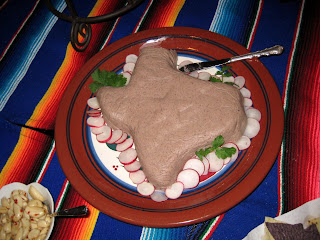
Black Bean Pate
Ceviche with
Red Snapper, Scallops and Shrimp
Guacamole with Oranges
Pickled Garlic (from Low Country Produce-TRY THIS!)
Salsa de Aji Amarillo*
Blue Corn Tostados
Served with
‘06 Columbia Crest “Vineyard 10” - WA. State
’04 Albert Seltz Gewurztraminer - Alsace
Platillo fuerte (Main Course)
Open Faced Turkey Tamales with Mole Sauce
Squash simmered with Cream
Mexican Rice
Served with
‘07 Crios de Susana Balbo Malbec – Argentina
’07 Ferrari-Carano Fume Blanc – Sonoma Co.
Postre (Dessert)
Texas Pecan Tart with Blue Bell Vanilla Ice Cream
Drizzled with
Leaning Oaks Cabernet Chocolate Sauce
Served with
NV Domaine Chandon Brut Classic – Napa Valley
So as not to be just guessing about these pairings, we prepared a “Chef’s Table” a few weeks earlier. Margaritas and beer usually tend to be the beverages of choice with this kind of cuisine. However, matching the spicy flavors with the nuances of wine was fun and educational. All in all, the combinations worked well, and with us serving two very different wines with both the appetizers and the main course, I think everyone found something they liked.
Without question, for me, the standout combination was the food friendly Malbec with the tamales… and to get back to the tamale story… In the midst of testing the tamale recipe several times, I became aware of a local cooking contest in progress, sponsored by our newspaper The Knoxville News Sentinel, a grocery store chain, and a local TV and radio station among others.
The contest was a part of a much larger event known as the Women Today Expo. The event featured a number of celebrity appearances including ABC’s Robin Roberts. The Expo also included a Cooking School segment featuring local chef and “Hell’s Kitchen” star, Carol Scott. Former White House Chef Walter Scheib and TV cake baking Master Warren Brown wowed the crowd with demos and signed copies of their respective cookbooks.
Rounding out the culinary production were the three winners of the recipe contest.
There were 3 categories including “Eat Light, Eat Cheap and Eat Sweet”- Cheryl Hodge won the “Eat Sweet’ with her Applesauce Spice Pudding Cake, Mary Gushen’s Ultimate Inexpensive Chicken Enchiladas took “Eat Cheap” and my own Open Faced Turkey Tamales won the “Eat Light” competition.
I think my wife, Gail and I made those tamales about 5 times in the course of a few weeks, including the demo at the Women Today Expo itself. Gail and I also offered a short tamale presentation at the wine society dinner, assisted by our good friend and noted Food Stylist, Linda Ullian Schmid, to whom we are much indebted.
Although, I have never though of myself as “The Hot Tamale Man”, I guess now I have some claim on the title. Surely, my parents would have been highly amused.
We offer a big “Muchas Gracias” to Bob and Judy Kryter and to the members of The American Wine Society. We also must thank Mary Constantine, Erin Slocum and the rest of the News Sentinel staff. Kudos and appreciation also go to Chris Kahn and her remarkable team of volunteers that worked so hard to make the Women Today Expo a reality.
*Aji Amarillo (Capsicum baccatum) is arguably the most popular hot pepper in Peru. It is a particularly beautiful pepper with a bright shiny yellow-orange skin. It is considered to be a medium hot pepper but that also depends on your personal taste. The flavor is fruity and aromatic and altogether delicious!
Although, this is not an ingredient common to our local markets, we are fortunate to be able to have access to it by way of our generous friends, J Owen Peterson and his wife, Thea Barrios Peterson. Thea is originally from Peru and still has many family members in that country. Owen is a noted professional photographer www.customphotographicservices.com and amateur grower of Aji peppers. In an upcoming blog, he has promised to share both photos and family recipes with us. We enjoyed serving the bright sauce Owen made using these peppers with our Southwestern dinner. THANKS!
Open-faced turkey tamales
Filling:
1 tablespoon olive oil
1 large white onion, chopped
1 green pepper, chopped
2 pounds ground turkey
2 cloves garlic, minced and mashed
2 tablespoons ground cumin
1 1/2 teaspoon salt
1 teaspoon oregano
1 teaspoon thyme
1 pickled jalapeno pepper, finely chopped
One (8-ounce) can tomato sauce
Dough:
2 quarts chicken or turkey stock
1 tablespoon salt
2 teaspoon ground cumin
2 cups Masa Harina
32 dried corn husks soaked in warm water
1 cup (per pan) of chicken or turkey stock for steaming
Saute onion and green pepper in oil until soft. Stir in turkey, garlic, cumin, salt, oregano, thyme and jalapeno pepper. Cook until turkey is done, about 6-8 minutes. Pour in tomato sauce, cook another 5 minutes and set aside to cool. Make dough by bringing the stock, salt and cumin to a boil in a large stockpot. Very gradually whisk in Masa Harina to stock so that it doesn’t lump. Reduce heat to simmer. Cook 15 to 20 minutes until it is quite thick, stirring frequently. Let cool at least 10 minutes. Pat corn husks dry and spread 3 tablespoons of the dough about 1/4 inch thick over the middle of the each husk. Top with scant 1/4 cup turkey filling. Gather together each end of the tamale and tie with a strip of corn husk. Leave the middle open with the filling showing.
Preheat oven to 350 degrees. Arrange tamales in one layer on bottom of baking pans (will need more than one.) Bring stock to a boil and, in each dish, pour 1 cup stock around the tamales. Cover with a lightly oiled piece of aluminum foil and place in oven. Cook for approximately 45 minutes. Serve plain or with Ranchero or Mole sauce. Yield: 24-30 tamales, depending upon how generously filled.
So, they invented a subterfuge that must have worked for a number of years, at least until the other kids clued me into reality. My folks told me that the man with the cart was the “Hot Tamale Man” and assured me that I wouldn’t care for hot tamales. Remembering the “Hot Tamale Man” with senior members of my family can still bring us all a chuckle.
Now, as fate would have it, when I actually discovered real tamales I liked them very much. Clearly, so did the early inhabitants of Mexico, who were enjoying a whole range of tamales long before the Spaniards arrived.
There is still an enormous variety of tamales available all over the different regions of Mexico, as well as an enormous variety prepared in regions across America. Some of these are reflections of traditional Mexican cooking and some are created according to the whims of the individual cooks. My tamale story involves a little of both tradition and whim.
A few months ago, our friends with the American Wine Society requested that we do a program matching wine with Southwestern cuisine. I had really wanted to do this for some time and here was the chance. We celebrated our “fiesta” at the beautiful home of society members Bob and Judy Kryter.
It was not a particular region of Mexico that inspired me nor a specific adaptation from the Southwestern border states, although I was certainly influenced by my work and travels. “Comida Nueva” is a definition probably closer to the mark, but when asked about the definition of “Southwestern cuisine”, my answer was, “whatever we want it to be”… I really wasn’t trying to be smart-alecky, but I was trying to make a point – that being the fact that a whole new wave of culinary excitement has swept the US in the last few decades. New American, Regional American, and Fusion Cuisine – it can have several names but we are basically talking about classic cooking techniques paired with regional foodstuffs.
This is the major theme (some might say obsession) in my career. In the early 80s, I wrote in the preface for our book, A TEXAS FAMILY’S COOKBOOK -“Americans have become much more sophisticated in their native cookery. This grafting of classic techniques onto good home cooking is a major milestone in our national culinary history. …explore the New American Cooking; refining familiar dishes with classic preparation techniques and an increased awareness of health and nutrition. Perhaps this “new” cooking is simply a deeper appreciation of our potential of producing a cuisine truly global in scope and authority.”
Over 25 years later in his 2007 book, WHITE HOUSE CHEF, Chef Walter Scheib, indicates that his staff was directed toward “…making the White House a showcase for what our farmers and other culinary purveyors were creating, and also for the style being forged by modern American chefs who wove indigenous American ingredients and international elements and styles together into an exciting, ever-changing cuisine that defied easy description- and was garnering a great deal of attention from coast to coast and around the world.”
Now, my fun little dinner hardly aspires to the lofty heights of White House cuisine, but I think Chef Scheib’s observation is well taken. The recipes used were our own creations and adaptations with the exception of the Mole Poblano, which is taken from Diana Kennedy’s authoritative classic, THE CUISINES OF MEXICO. If you have the slightest interest in the cuisine and culture of Mexico, this is a cookbook that must be in your library.
Here is our menu and a list of the wines we enjoyed.
Quaffing Wine: White Wine Spritzer with lime
Antojitos (Appetizers)

Black Bean Pate
Ceviche with
Red Snapper, Scallops and Shrimp
Guacamole with Oranges
Pickled Garlic (from Low Country Produce-TRY THIS!)
Salsa de Aji Amarillo*
Blue Corn Tostados
Served with
‘06 Columbia Crest “Vineyard 10” - WA. State
’04 Albert Seltz Gewurztraminer - Alsace
Platillo fuerte (Main Course)
Open Faced Turkey Tamales with Mole Sauce

Squash simmered with Cream
Mexican Rice
Served with
‘07 Crios de Susana Balbo Malbec – Argentina
’07 Ferrari-Carano Fume Blanc – Sonoma Co.
Postre (Dessert)
Texas Pecan Tart with Blue Bell Vanilla Ice Cream
Drizzled with
Leaning Oaks Cabernet Chocolate Sauce
Served with
NV Domaine Chandon Brut Classic – Napa Valley
So as not to be just guessing about these pairings, we prepared a “Chef’s Table” a few weeks earlier. Margaritas and beer usually tend to be the beverages of choice with this kind of cuisine. However, matching the spicy flavors with the nuances of wine was fun and educational. All in all, the combinations worked well, and with us serving two very different wines with both the appetizers and the main course, I think everyone found something they liked.
Without question, for me, the standout combination was the food friendly Malbec with the tamales… and to get back to the tamale story… In the midst of testing the tamale recipe several times, I became aware of a local cooking contest in progress, sponsored by our newspaper The Knoxville News Sentinel, a grocery store chain, and a local TV and radio station among others.
The contest was a part of a much larger event known as the Women Today Expo. The event featured a number of celebrity appearances including ABC’s Robin Roberts. The Expo also included a Cooking School segment featuring local chef and “Hell’s Kitchen” star, Carol Scott. Former White House Chef Walter Scheib and TV cake baking Master Warren Brown wowed the crowd with demos and signed copies of their respective cookbooks.
Rounding out the culinary production were the three winners of the recipe contest.
There were 3 categories including “Eat Light, Eat Cheap and Eat Sweet”- Cheryl Hodge won the “Eat Sweet’ with her Applesauce Spice Pudding Cake, Mary Gushen’s Ultimate Inexpensive Chicken Enchiladas took “Eat Cheap” and my own Open Faced Turkey Tamales won the “Eat Light” competition.
I think my wife, Gail and I made those tamales about 5 times in the course of a few weeks, including the demo at the Women Today Expo itself. Gail and I also offered a short tamale presentation at the wine society dinner, assisted by our good friend and noted Food Stylist, Linda Ullian Schmid, to whom we are much indebted.
Although, I have never though of myself as “The Hot Tamale Man”, I guess now I have some claim on the title. Surely, my parents would have been highly amused.
We offer a big “Muchas Gracias” to Bob and Judy Kryter and to the members of The American Wine Society. We also must thank Mary Constantine, Erin Slocum and the rest of the News Sentinel staff. Kudos and appreciation also go to Chris Kahn and her remarkable team of volunteers that worked so hard to make the Women Today Expo a reality.
*Aji Amarillo (Capsicum baccatum) is arguably the most popular hot pepper in Peru. It is a particularly beautiful pepper with a bright shiny yellow-orange skin. It is considered to be a medium hot pepper but that also depends on your personal taste. The flavor is fruity and aromatic and altogether delicious!
Although, this is not an ingredient common to our local markets, we are fortunate to be able to have access to it by way of our generous friends, J Owen Peterson and his wife, Thea Barrios Peterson. Thea is originally from Peru and still has many family members in that country. Owen is a noted professional photographer www.customphotographicservices.com and amateur grower of Aji peppers. In an upcoming blog, he has promised to share both photos and family recipes with us. We enjoyed serving the bright sauce Owen made using these peppers with our Southwestern dinner. THANKS!
Open-faced turkey tamales
Filling:
1 tablespoon olive oil
1 large white onion, chopped
1 green pepper, chopped
2 pounds ground turkey
2 cloves garlic, minced and mashed
2 tablespoons ground cumin
1 1/2 teaspoon salt
1 teaspoon oregano
1 teaspoon thyme
1 pickled jalapeno pepper, finely chopped
One (8-ounce) can tomato sauce
Dough:
2 quarts chicken or turkey stock
1 tablespoon salt
2 teaspoon ground cumin
2 cups Masa Harina
32 dried corn husks soaked in warm water
1 cup (per pan) of chicken or turkey stock for steaming
Saute onion and green pepper in oil until soft. Stir in turkey, garlic, cumin, salt, oregano, thyme and jalapeno pepper. Cook until turkey is done, about 6-8 minutes. Pour in tomato sauce, cook another 5 minutes and set aside to cool. Make dough by bringing the stock, salt and cumin to a boil in a large stockpot. Very gradually whisk in Masa Harina to stock so that it doesn’t lump. Reduce heat to simmer. Cook 15 to 20 minutes until it is quite thick, stirring frequently. Let cool at least 10 minutes. Pat corn husks dry and spread 3 tablespoons of the dough about 1/4 inch thick over the middle of the each husk. Top with scant 1/4 cup turkey filling. Gather together each end of the tamale and tie with a strip of corn husk. Leave the middle open with the filling showing.
Preheat oven to 350 degrees. Arrange tamales in one layer on bottom of baking pans (will need more than one.) Bring stock to a boil and, in each dish, pour 1 cup stock around the tamales. Cover with a lightly oiled piece of aluminum foil and place in oven. Cook for approximately 45 minutes. Serve plain or with Ranchero or Mole sauce. Yield: 24-30 tamales, depending upon how generously filled.
Wednesday, March 4, 2009
SOUTHWESTERN CUISINE NEW AND OLD

…a serious influence
The American Southwest will always be a serious influence in my cooking and lifestyle.
Not only are there many regionally based cuisines in Mexico itself, but there are also unique variations in the American states bordering Mexico as well.
..."specialties" can run the gamut
This can include specialties from each of the border states- California, Arizona, New Mexico and Texas. Those “specialties” can run the gamut from authentic Mexican traditions to highly adapted and popular cooking styles such as Tex-Mex. This does not even touch on the creative “Nueva” cooking from South Florida reflecting both Latin American and Caribbean influences.
…you will notice distinctly different styles
Even if you have wandered across the Border States (like I have) tasting food in the small Mexican restaurants along the way, you will have noticed distinctly different styles in the cooking of say, south Texas and northern New Mexico. There are also many chefs experimenting with combining the new and old in examples of crossover fusion cooking.
…it is quite possible to preserve authentic…classics…while encouraging innovation
Such innovation is not without controversy; although it seems to me that it is quite possible to preserve authentic regional classics while at the same time encouraging innovation and creativity in the kitchen. Such concepts as fusion, New American, New Regional American or even more specifically Comida Nueva are in a sense not new at all. The term “New American Cuisine” can probably mean just about anything. For my purposes here I define it as a combination of favorite regional foods and any number of international cooking techniques.
Antoine’s …can hardly considered modern or trendy
With the celebration of Mardi gras still fresh in my mind, I’m reminded of a very interesting conversation that I once enjoyed over lunch with Bernard R.Guste at his French Quarter restaurant, Antoine’s. Mr. Guste is the fifth-generation proprietor at the landmark New Orleans Creole establishment. Founded in 1840, this classic Creole eatery can hardly be considered modern or trendy. Yet, more that 150 years ago, this restaurant was experimenting with what can be called “New American Cuisine.”
Lacking a suitable snail in southern Louisiana…
As Guste tells the story, his great, great grandfather, remembering the succulent escargot of his native France, wished to serve something similar at his New Orleans restaurant. Lacking a suitable snail in southern Louisiana, he turned to an interesting substitute. In a move that would be considered rank heresy to many of his countrymen, the chef opened fresh oysters, packed the shell with delicious green herb sauce and baked them on a bed of rock salt. Thus was born Oysters Rockefeller, the original recipe still a secret to this day. Mr. Guste’s story has always seemed to me to be the perfect example of how to explain the rationale behind the New American movement.
My own tinkering…has not always been greeted by such enthusiasm.
Now, although generations of Americans have delighted in this chef’s innovation, my own tinkering with tradition has not always been greeted by such enthusiasm. Once upon a time, I suggested a minimal effort to make the lowly taco more appealing and acceptable to a vegetarian. My idea was to replace ground beef with a mixture of brown rice, cracked wheat and tofu flavored with easily recognized Mexican seasoning. It was really almost an afterthought and not one in which I had invested much time or energy. That being admitted, look at the extreme reaction that my recipe received from a food writer in one of the major Texas daily newspapers.
Real Texan (?)…
“We offer the following, not as a recipe we expect any real Texan actually to prepare and eat, but as an example of how New Age food mongrelization debases tradition.”
...self-appointed cultural arbitrators
Well now…….of course, I had to respond in kind! So, I said, “when self-appointed cultural arbitrators retreat into complaints about what a “real” Texan or “real” anyone might do or eat, it leaves me more than a little suspicious of that person’s sense of identity. Scratch the surface of someone crying about being a “real” Texan and often you will find just another self-consciously insecure urban cowboy wannabe!”
Naturally, I will share the recipe with you, let you judge for yourselves and hopefully inspire you to post some comments of your own.
TEXAS TOFU TACOS
Makes about 12 hearty tacos
18 oz. firm tofu
1 cup cooked crack wheat
½ cup cooked brown rice
2 cloves garlic, minced and mashed
1 small white onion, finely chopped
1 ½ tsps. Salt or to taste
½ tsp. crushed red pepper
1 tsp. whole cumin seed, lightly toasted
3 Tblsp. tomato paste
¼ cup Avanti Savoia all-purpose cooking olive oil
12 corn tortillas
½ cup Monterey Jack cheese, grated
1. Crumble tofu into a bowl with cooked cracked wheat and brown rice.
2. Add minced garlic and chopped onion to tofu-grain mixture along with salt, red pepper, cumin seed and tomato paste. Toss lightly.
3. Heat oil in a large skillet and stir in tofu-grain mixture. Cook 3 or 4 minutes or until sizzling and hot.
4. Heat tortillas home style by placing each one directly on a medium burner, either gas or electric, for just enough time to mark each side. Just a few seconds will be enough and a little practice will make you comfortable with the process.
5. Serve taco mix with heated tortillas and grated cheese. Allow guests to fill their own tacos.
6. Serve with guacamole, salsa and fresh sprigs of cilantro.
Texas Independence Day
On March 2, 2009 Texas celebrated 173 years of independence. We are observing the occasion not only with this post exploring culinary tradition and innovation, but also with a Southwestern “fiesta” for our friends, the East Tennessee Chapter of the American Wine Society. The menu will include Antojitos (Appetizers), Platillo fuerte (Main Course) and Postre (Dessert). The photo on this post is of the Main Course, Open Faced Turkey Tamales with Mole Sauce. Check out our next post with the complete menu, recipes, fiesta photos and a selection of wines carefully chosen to match the many flavors.
MARDI GRAS POSTSCRIPT:
Sometimes it’s easy to let simple things slip your mind. Like for instance, just how luscious our Carnaroli rice from Cascina Belvedere really is. Aroma, flavor, beautiful appearance and delicate texture... this plump, white rice from the Piedmont and Lombardy regions almost upstaged the gumbo we served with it for Mardi gras.
Wednesday, October 15, 2008
THE GARDEN THING
"A bumper crop of weeds"
MAY ‘08
My wife, Gail and I planted our first garden together in the summer of 1996. We were very excited about it and spent a great deal of time (for the next eleven years) building our soil, tending, harvesting and enjoying. Some years we managed three different seasonal plantings and Gail canned with a passion. Last spring we both faced some health issues and in truth, we were also just really tired of the hard work and daily responsibility. So, for over a year we allowed the garden to “lay fallow” and produce a bumper crop of weeds.
"A reason to escape going to the gym"
However, a good break seems to have been very beneficial, at least for us and maybe for our garden. We have in years past, cultivated thirty two-12 foot rows. Work that was mostly accomplished using hand tools and a lot of effort. I saw the hard labor as a reason to escape going to the gym and there was a real satisfaction from the work and the edible results. This year we have decided that we would invest in some better machinery including a fine new tiller. There is still plenty of exercise involved and it is certainly more practical. We have also cut down on the amount of tilling required by cultivating only the rows in which we plant.
"Certain patterns have emerged"
I have been interested to note the upsurge of interest in gardens this year partly due to the downturn in the economy. I suppose that perhaps money can be saved on groceries by growing your own, but it is not a freebie- not by a long shot. Over our previous years of experience certain patterns have emerged. A half acre of corn proved to be a 3 year exercise in frustration due to the damage from storms, droughts and marauding raccoons. At the rate at which two people can enjoy fresh corn, it is easier and more economical to just purchase it from some local farmers. Any financial savings by way of a garden will be welcome of course, but for us it is really about the fantastic flavor, quality and purity.
We are planting the crops that we have had the best experience with in the past in terms of maintenance and productivity. This year that means tomatoes, peppers, beans, okra, lettuce, onions, greens, cucumbers, eggplants, herbs and flowers.
"That vision of the bounty of beautiful produce"
JUNE ‘08
Gardens always start out as an exercise in some kind of faith. Faith that those seeds will sprout, the seedlings will grow, the bugs and diseases will give you a break and that there will be enough sunlight and rain. How else could anyone put so much work and effort into a project if there wasn’t a great deal of faith that it will succeed? Then there is that vision of the bounty of beautiful produce. Now, after a month or so this particular year’s challenges began to be apparent, as I guess they are every year.
First, we seem to have a problem with our seed crops sprouting, especially the flowers and some of the herbs. Even old reliables like sunflowers are coming up with big gaps or simply not coming up at all. The pepper sets are small and growing very slowly. Everything else seems slow and a little stunted… Hmmm… to replant or not…Hmm.The lettuces and onions are delicious.
We have plenty of fresh basil, 24 feet of in fact. We call it Vito’s Basil Patch in honor of our Italian Partner at Avanti Savoia, Vito De Carolis. There are tomatoes, cukes and okra coming along and there is still hope. I don’t think one can garden without hope.
"RAIN "
It is dry and even though I have been watering, it really is not the same as rain. I am beginning to worry about our crop of wild raspberries. There are plenty of buds but some of the leaves are withering and that means that they are thirsty! We usually harvest around the 4th of July, but for that to happen…well, you know-RAIN. We depend on well water at Cabbage Creek (that’s what we named our little mini-farm) for drinking and living as well as watering the garden. Our well has never run out but I monitor the springs and creek all year just to get a clue about the water table level and it’s not looking good. If we reach a certain point I will be very reluctant to use any more well water than necessary.
Our next issue is sunlight- in the year and a half since we have had a garden, I’m wondering if the surrounding trees have grown just enough to make shade a problem. Removing a bunch of big branches might do it, but that will require some outside assistance.
JULY ‘08
I’ve been monitoring the amount of sunlight in the garden very carefully and I’m now convinced that there is just not quite enough. We are harvesting beans, tomatoes, cucumbers, eggplants, lettuce, onions, cilantro and basil. But the amount of the harvest is not what it should be by this time of the season. I’m beginning to doubt whether or not there will be any peppers at all.
"Berry pickin’ party"
The rains have come however, and just in time. Not enough to really erase our rainfall deficit, but enough to help out the garden and bring on a decent harvest of raspberries. We look for them to be ripe the first part of July each year and sure enough, they were right on time. We had a “berry pickin’ party” a couple of days after the 4th of July with some friends and family. Baskets full of ripe raspberries are a beautiful sight. Although, I found myself down with a back ache, we did manage a good harvest and a good time. As is our tradition, we enjoyed fresh raspberry Margaritas with our guests.
As the month has slipped by, my priority in the garden has been weeding and mulching.
The weeds not only steal moisture and nourishment, they also block precious sunlight from the less tall plants. The mulching is indispensable in preventing more weed growth and the conservation of moisture along the plant rows.
Finally, the pepper plants are blooming and putting on more foliage, we will probably get a few anyway, but I doubt that they will be prolific. Some seasons we have been almost overwhelmed with the abundance of peppers. Like the old cliché, “feast or famine” this is going to be a thin year for peppers.
AUGUST ‘08
"All the hard work pays off (or sometimes not) "
Summer is half over and the hottest and most humid time of the year is here. In the northern hemisphere this time has been known as “the dog days of summer”, since the time of the Egyptians. As miserable a time as it can be, it is also the heart of the harvest time in our garden as well as the time for fall planting. We already have a row of mixed greens from which we have just now started harvesting, but within the last few days we will have planted radishes, turnips, spinach and a row of lettuce. Each year we usually plant a progression of lettuces over the season, so when one row plays out we have a new one ready to supply us with fresh salads. This is the time that all the hard work pays off (or sometimes not) and that we get to enjoy real garden bounty! We have also been fortunate in as much as the rains have come just in time the last few weeks.
"Okra"
My wife Gail has been busy caning. Beans, pickles and a particularly southern specialty, pickled okra. Okra was brought to America from Africa (some say Ethiopia, actually) and cultivation quickly spread all over the south. Besides being pickled, fresh okra is also enjoyed fried, steamed, braised, boiled and perhaps it is best known as an ingredient in some gumbos. Okra is a food that most people either love or hate. Okra does produce a viscous substance when cooked that is useful as a thickener, although some folks find it “slimy” and reject it on that basis alone. If you have access to the pods when they are very small (about 3 inches) they are delicious and less slimy when lightly steamed and served with Hollandaise sauce.
In just the last few days it is clear that the beans and cukes are on their last leg as expected this time of year. It makes the last of them even “sweeter”, knowing that their time is about over. But as one vegetable fades and takes its final bow, another fills its place. In this case our first good “mess” of mixed greens has arrived and they are excellent.
"Amaranth"
Also, even though I have not yet mentioned it, we have been harvesting and eating Amaranth greens all summer. Amaranth was once considered a weed and in practical terms, in our garden it still is- albeit a delicious and very nutritious one. We first planted it 6 or 7 years ago as a novelty and then discovered just how adapt it is in returning each year. It grows, well like a weed. But instead of just removing it from where it pops up, we eat it. Very similar in flavor and texture to spinach and interchangeable in any recipe calling for spinach, which is a good thing considering that we will probably never be able to get rid of it.
SEPTEMBER ‘08
"The garden is not going to be overgrown this year"
We are thankful that our well water has remained dependable, because we had only one significant rain during the whole month of August. As I have already noted, the 2008 season has not been our most prolific garden but still satisfying enough. Our fall crops are developing nicely, better actually than our spring plantings and the promise of fall is right around the corner. I’m already beginning to think about turning under spent rows and building the soil over the winter. No matter what we decide to plant next spring, the garden is not going to be overgrown this year.
"Like tattered curtains in an old abandoned house"
Now, it is the last few days of summer and although hardly the end of the garden, everything has changed. The formerly lush cucumber vines are pale and very dead. They flutter in the breeze like tattered curtains in an old abandoned house. In the next day or two I will pull them up and discard them. The okra has stopped producing entirely, but to my surprise the Half White Runner beans have still been making, as are the tomatoes. At long last, the peppers are finally doing great. The basil will fade soon, even though we have kept it well tended and enjoyed it often. We will probably freeze some, but it just isn’t the same as fresh.
"Moon flowers "
We are still enjoying several varieties of cutting flowers and a particular pleasure for us has been the moon flowers (Ipomoea alba). If you don’t know this beautiful ornamental, you should. In our region it is grown as an annual and blooms in the evening, so as to be pollinated by the moth population. Huge white blossoms on trailing vines makes for an impressive showing, but they have no food use and are in fact, poisonous.
"THE AUTUMN TRANSITION "
With the summer season ended, we now begin to weigh the benefits of our garden versus the drawbacks. First, the costs- as I have noted, gardening is not a free lunch, but it is a big lunch! Even if our produce was not in huge amounts, there was still plenty to eat and enough for limited canning. I’m not really sure that my wife would have found time for a monster canning season anyway.
"Committed to growing our garden organically"
Then there is the quality, which is excellent, but as with anything organic not perfectly symmetrical or without blemishes. We are committed to growing our garden organically. To us, that means growing without chemical pesticides or fertilizers. Going “green” in this sense also means less polluted soil, groundwater, rivers, streams, and creeks. In years past I have noted with alarm the increasing “bloom” of algae in our own Cabbage Creek from the wash off of chemical fertilizers from other farms further upstream. It also means less dependence on commercial produce that has to be trucked in resulting in the use of more fossil fuels.
Another very important piece of this picture is composting! We save most kitchen scraps (except flesh and bones) for the compost pile. We actually have two 10’ X 10’ pits in which we dump our scraps along with other yard waste. We harvest the composted matter from each pit alternatively and work it into our soil. This method not only provides an excellent alternative to commercial fertilizers but makes our garbage much less offensive.
Sitting in a shaded spot…sipping a little wine
Perhaps less tangible, but still very valuable to us is the simple pleasure we receive from just working the soil, tending our crops and just spending time together outside in such a beautiful setting. Some of my best memories of our gardening experience involve sitting in a shaded spot at the end of a day sipping a little wine and talking quietly with my wife Gail.
"Garden journaling"
Will we do it again next year? Absolutely! Although this post is (finally) ending here, I have been so inspired by the garden journaling experience that I plan to continue writing about it each month. I’m looking forward to sharing that collection of thoughts with you again in the early spring of 2009.
The salads of “Cabbage Creek” have long been a favorite of ours and our guests. Access to the wonderful extra virgin olive oils, balsamic and wine vinegars and other seasonings from Avanti Savoia only enhances the prospects. A salad bowl with fresh baby lettuces is always welcome with any number of variations based on this simple vinaigrette dressing.
Basic American Vinaigrette
Yields about 1 cup
Ingredients: (* available at Avanti Savoia.com)
½ cup *Red (#25001) or *White (#25002) Wine Vinegar by Claudio Rosso
2 tsp. Sel Gris Velvet sea salt* #35049
1 Tblsp. freshly ground black peppercorn* #32000
3 cloves fresh garlic, minced and mashed
½ tsp. sweet paprika* #32100
1 Tblsp. Dijon mustard
4 to 6 Tblsps. Avanti Savoia extra virgin olive oil* #10090
In a small bowl, combine salt and vinegar and beat well.
Add pepper, garlic, paprika, and Dijon. Mix well.
Next, beat in oil until smooth and toss with salad.
Do note that this is an American version, not classic Italian Vinaigrette. If you should wish to be a little more authentically Italian, try Don Vito’s Classic Italian Vinaigrette recipe from our August 12, 2008 post entitled “A Conversation Between Cooks.” The vinaigrette should not be made until just before using and the salad should not be dressed until ready to serve.
MAY ‘08
My wife, Gail and I planted our first garden together in the summer of 1996. We were very excited about it and spent a great deal of time (for the next eleven years) building our soil, tending, harvesting and enjoying. Some years we managed three different seasonal plantings and Gail canned with a passion. Last spring we both faced some health issues and in truth, we were also just really tired of the hard work and daily responsibility. So, for over a year we allowed the garden to “lay fallow” and produce a bumper crop of weeds.
"A reason to escape going to the gym"
However, a good break seems to have been very beneficial, at least for us and maybe for our garden. We have in years past, cultivated thirty two-12 foot rows. Work that was mostly accomplished using hand tools and a lot of effort. I saw the hard labor as a reason to escape going to the gym and there was a real satisfaction from the work and the edible results. This year we have decided that we would invest in some better machinery including a fine new tiller. There is still plenty of exercise involved and it is certainly more practical. We have also cut down on the amount of tilling required by cultivating only the rows in which we plant.
"Certain patterns have emerged"
I have been interested to note the upsurge of interest in gardens this year partly due to the downturn in the economy. I suppose that perhaps money can be saved on groceries by growing your own, but it is not a freebie- not by a long shot. Over our previous years of experience certain patterns have emerged. A half acre of corn proved to be a 3 year exercise in frustration due to the damage from storms, droughts and marauding raccoons. At the rate at which two people can enjoy fresh corn, it is easier and more economical to just purchase it from some local farmers. Any financial savings by way of a garden will be welcome of course, but for us it is really about the fantastic flavor, quality and purity.
We are planting the crops that we have had the best experience with in the past in terms of maintenance and productivity. This year that means tomatoes, peppers, beans, okra, lettuce, onions, greens, cucumbers, eggplants, herbs and flowers.
"That vision of the bounty of beautiful produce"
JUNE ‘08
Gardens always start out as an exercise in some kind of faith. Faith that those seeds will sprout, the seedlings will grow, the bugs and diseases will give you a break and that there will be enough sunlight and rain. How else could anyone put so much work and effort into a project if there wasn’t a great deal of faith that it will succeed? Then there is that vision of the bounty of beautiful produce. Now, after a month or so this particular year’s challenges began to be apparent, as I guess they are every year.
First, we seem to have a problem with our seed crops sprouting, especially the flowers and some of the herbs. Even old reliables like sunflowers are coming up with big gaps or simply not coming up at all. The pepper sets are small and growing very slowly. Everything else seems slow and a little stunted… Hmmm… to replant or not…Hmm.The lettuces and onions are delicious.
We have plenty of fresh basil, 24 feet of in fact. We call it Vito’s Basil Patch in honor of our Italian Partner at Avanti Savoia, Vito De Carolis. There are tomatoes, cukes and okra coming along and there is still hope. I don’t think one can garden without hope.
"RAIN "
It is dry and even though I have been watering, it really is not the same as rain. I am beginning to worry about our crop of wild raspberries. There are plenty of buds but some of the leaves are withering and that means that they are thirsty! We usually harvest around the 4th of July, but for that to happen…well, you know-RAIN. We depend on well water at Cabbage Creek (that’s what we named our little mini-farm) for drinking and living as well as watering the garden. Our well has never run out but I monitor the springs and creek all year just to get a clue about the water table level and it’s not looking good. If we reach a certain point I will be very reluctant to use any more well water than necessary.
Our next issue is sunlight- in the year and a half since we have had a garden, I’m wondering if the surrounding trees have grown just enough to make shade a problem. Removing a bunch of big branches might do it, but that will require some outside assistance.
JULY ‘08
I’ve been monitoring the amount of sunlight in the garden very carefully and I’m now convinced that there is just not quite enough. We are harvesting beans, tomatoes, cucumbers, eggplants, lettuce, onions, cilantro and basil. But the amount of the harvest is not what it should be by this time of the season. I’m beginning to doubt whether or not there will be any peppers at all.
"Berry pickin’ party"
The rains have come however, and just in time. Not enough to really erase our rainfall deficit, but enough to help out the garden and bring on a decent harvest of raspberries. We look for them to be ripe the first part of July each year and sure enough, they were right on time. We had a “berry pickin’ party” a couple of days after the 4th of July with some friends and family. Baskets full of ripe raspberries are a beautiful sight. Although, I found myself down with a back ache, we did manage a good harvest and a good time. As is our tradition, we enjoyed fresh raspberry Margaritas with our guests.
As the month has slipped by, my priority in the garden has been weeding and mulching.
The weeds not only steal moisture and nourishment, they also block precious sunlight from the less tall plants. The mulching is indispensable in preventing more weed growth and the conservation of moisture along the plant rows.
Finally, the pepper plants are blooming and putting on more foliage, we will probably get a few anyway, but I doubt that they will be prolific. Some seasons we have been almost overwhelmed with the abundance of peppers. Like the old cliché, “feast or famine” this is going to be a thin year for peppers.
AUGUST ‘08
"All the hard work pays off (or sometimes not) "
Summer is half over and the hottest and most humid time of the year is here. In the northern hemisphere this time has been known as “the dog days of summer”, since the time of the Egyptians. As miserable a time as it can be, it is also the heart of the harvest time in our garden as well as the time for fall planting. We already have a row of mixed greens from which we have just now started harvesting, but within the last few days we will have planted radishes, turnips, spinach and a row of lettuce. Each year we usually plant a progression of lettuces over the season, so when one row plays out we have a new one ready to supply us with fresh salads. This is the time that all the hard work pays off (or sometimes not) and that we get to enjoy real garden bounty! We have also been fortunate in as much as the rains have come just in time the last few weeks.
"Okra"
My wife Gail has been busy caning. Beans, pickles and a particularly southern specialty, pickled okra. Okra was brought to America from Africa (some say Ethiopia, actually) and cultivation quickly spread all over the south. Besides being pickled, fresh okra is also enjoyed fried, steamed, braised, boiled and perhaps it is best known as an ingredient in some gumbos. Okra is a food that most people either love or hate. Okra does produce a viscous substance when cooked that is useful as a thickener, although some folks find it “slimy” and reject it on that basis alone. If you have access to the pods when they are very small (about 3 inches) they are delicious and less slimy when lightly steamed and served with Hollandaise sauce.
In just the last few days it is clear that the beans and cukes are on their last leg as expected this time of year. It makes the last of them even “sweeter”, knowing that their time is about over. But as one vegetable fades and takes its final bow, another fills its place. In this case our first good “mess” of mixed greens has arrived and they are excellent.
"Amaranth"
Also, even though I have not yet mentioned it, we have been harvesting and eating Amaranth greens all summer. Amaranth was once considered a weed and in practical terms, in our garden it still is- albeit a delicious and very nutritious one. We first planted it 6 or 7 years ago as a novelty and then discovered just how adapt it is in returning each year. It grows, well like a weed. But instead of just removing it from where it pops up, we eat it. Very similar in flavor and texture to spinach and interchangeable in any recipe calling for spinach, which is a good thing considering that we will probably never be able to get rid of it.
SEPTEMBER ‘08
"The garden is not going to be overgrown this year"
We are thankful that our well water has remained dependable, because we had only one significant rain during the whole month of August. As I have already noted, the 2008 season has not been our most prolific garden but still satisfying enough. Our fall crops are developing nicely, better actually than our spring plantings and the promise of fall is right around the corner. I’m already beginning to think about turning under spent rows and building the soil over the winter. No matter what we decide to plant next spring, the garden is not going to be overgrown this year.
"Like tattered curtains in an old abandoned house"
Now, it is the last few days of summer and although hardly the end of the garden, everything has changed. The formerly lush cucumber vines are pale and very dead. They flutter in the breeze like tattered curtains in an old abandoned house. In the next day or two I will pull them up and discard them. The okra has stopped producing entirely, but to my surprise the Half White Runner beans have still been making, as are the tomatoes. At long last, the peppers are finally doing great. The basil will fade soon, even though we have kept it well tended and enjoyed it often. We will probably freeze some, but it just isn’t the same as fresh.
"Moon flowers "
We are still enjoying several varieties of cutting flowers and a particular pleasure for us has been the moon flowers (Ipomoea alba). If you don’t know this beautiful ornamental, you should. In our region it is grown as an annual and blooms in the evening, so as to be pollinated by the moth population. Huge white blossoms on trailing vines makes for an impressive showing, but they have no food use and are in fact, poisonous.
"THE AUTUMN TRANSITION "
With the summer season ended, we now begin to weigh the benefits of our garden versus the drawbacks. First, the costs- as I have noted, gardening is not a free lunch, but it is a big lunch! Even if our produce was not in huge amounts, there was still plenty to eat and enough for limited canning. I’m not really sure that my wife would have found time for a monster canning season anyway.
"Committed to growing our garden organically"
Then there is the quality, which is excellent, but as with anything organic not perfectly symmetrical or without blemishes. We are committed to growing our garden organically. To us, that means growing without chemical pesticides or fertilizers. Going “green” in this sense also means less polluted soil, groundwater, rivers, streams, and creeks. In years past I have noted with alarm the increasing “bloom” of algae in our own Cabbage Creek from the wash off of chemical fertilizers from other farms further upstream. It also means less dependence on commercial produce that has to be trucked in resulting in the use of more fossil fuels.
Another very important piece of this picture is composting! We save most kitchen scraps (except flesh and bones) for the compost pile. We actually have two 10’ X 10’ pits in which we dump our scraps along with other yard waste. We harvest the composted matter from each pit alternatively and work it into our soil. This method not only provides an excellent alternative to commercial fertilizers but makes our garbage much less offensive.
Sitting in a shaded spot…sipping a little wine
Perhaps less tangible, but still very valuable to us is the simple pleasure we receive from just working the soil, tending our crops and just spending time together outside in such a beautiful setting. Some of my best memories of our gardening experience involve sitting in a shaded spot at the end of a day sipping a little wine and talking quietly with my wife Gail.
"Garden journaling"
Will we do it again next year? Absolutely! Although this post is (finally) ending here, I have been so inspired by the garden journaling experience that I plan to continue writing about it each month. I’m looking forward to sharing that collection of thoughts with you again in the early spring of 2009.
The salads of “Cabbage Creek” have long been a favorite of ours and our guests. Access to the wonderful extra virgin olive oils, balsamic and wine vinegars and other seasonings from Avanti Savoia only enhances the prospects. A salad bowl with fresh baby lettuces is always welcome with any number of variations based on this simple vinaigrette dressing.
Basic American Vinaigrette
Yields about 1 cup
Ingredients: (* available at Avanti Savoia.com)
½ cup *Red (#25001) or *White (#25002) Wine Vinegar by Claudio Rosso
2 tsp. Sel Gris Velvet sea salt* #35049
1 Tblsp. freshly ground black peppercorn* #32000
3 cloves fresh garlic, minced and mashed
½ tsp. sweet paprika* #32100
1 Tblsp. Dijon mustard
4 to 6 Tblsps. Avanti Savoia extra virgin olive oil* #10090
In a small bowl, combine salt and vinegar and beat well.
Add pepper, garlic, paprika, and Dijon. Mix well.
Next, beat in oil until smooth and toss with salad.
Do note that this is an American version, not classic Italian Vinaigrette. If you should wish to be a little more authentically Italian, try Don Vito’s Classic Italian Vinaigrette recipe from our August 12, 2008 post entitled “A Conversation Between Cooks.” The vinaigrette should not be made until just before using and the salad should not be dressed until ready to serve.
Friday, September 26, 2008
A CHEF’S MEA CULPA
Eat Only the Plants That Are Proven Safe and Accurately Identified
An interesting situation has been reported in the news media, one that has caught my attention and given me real pause for thought. A British chef, Anthony Worrall Thompson has made a significant error in his recommendation of a wild plant to be used in summertime meals. His mistake has had me thinking about two very important observations: One, the common verses scientific names for various plants and Two, the source for food information that chefs pass on to their co-workers and students and ultimately in their food.
The story is that this chef in a magazine article stated that “Henbane” would make a nice addition to summertime meals. The problem is that Thompson meant to refer to the plant commonly known as “Fat Hen”. Definitely, he misspoke. “Henbane” (Hyoscyamus niger) is toxic and according to Wikapedia, “can cause hallucinations, convulsions, vomiting and in extreme cases death”.
In an article in Healthy and Organic Living magazine it is stated, “Henbane is a very toxic plant and should never be eaten. As always, check with an expert when foraging or collecting wild plants”.
What Chef Thompson meant to recommend was a plant known as “Fat Hen” (Chenopodium album) which is edible. This brings me to one of the problems in using only common names and not also referencing the scientific and therefore universal name.
For instance, neither of the names “Henbane” nor “Fat Hen” meant a thing to me. But, after a little researching, I realized that I’m totally unfamiliar with “Henbane”. “Fat Hen” however, is another name for “Lamb’s Quarter” (Chenopodium album), a plant that I’ve gathered and eaten for decades.
So, point taken- I will reference by the Latin terms for the plant family and species as I usually do. There are so many common names in so many languages that it is not only confusing to only use them, but potentially very harmful. That is my first observation, the second, (other that a real compassion for the embarrassment that the chef must have felt) is a long hard look at my own culinary use of wild plants.
You may already know of my fondness for wild mushrooms from a previous post entitled “Mushroom Paradise” in which I was careful to properly identify my mushrooms and recommend extreme caution in their harvest.
However, I have been given real pause to think about many other plants that I have used over the years. In particular, the wild Sweet Pea or Lathyrus ochroleucus, which although I have not eaten or tried to cook, I HAVE used the pretty little blossom as a garnish with all sorts of dishes. Never again of course, but fortune was on my side as apparently my mistake has never made anyone sick.
I do remember once when catering a private party in San Francisco in the early eighties, I used the blossoms to garnish a lovely cold strawberry soup. I was even confronted by one of the guests about the safety of the flower and my source for knowing that it was safe. In my “chefly” arrogance I answered that of course it was safe and that I had used it for years. I have used it for years and but the truth is I don’t remember how or who first inspired me to use it. My bad, and although not quite the faux pas of Chef Thompson, I was very wrong and have learned a most valuable lesson.
I do love foraging around for edible wild things and was a big fan years ago of the most famous proponent of wild food, Euell Gibbons. I carried around a copy of his book “Stalking the Wild Asparagus” until it was worn out. I still love wild asparagus (Asparagus officinalis) and still gather it every spring.
It is a safe bet that in the future if I mention wild foods in this blog or elsewhere it will have proper reference and identification! Eat well and safely!
An interesting situation has been reported in the news media, one that has caught my attention and given me real pause for thought. A British chef, Anthony Worrall Thompson has made a significant error in his recommendation of a wild plant to be used in summertime meals. His mistake has had me thinking about two very important observations: One, the common verses scientific names for various plants and Two, the source for food information that chefs pass on to their co-workers and students and ultimately in their food.
The chef misspoke
The story is that this chef in a magazine article stated that “Henbane” would make a nice addition to summertime meals. The problem is that Thompson meant to refer to the plant commonly known as “Fat Hen”. Definitely, he misspoke. “Henbane” (Hyoscyamus niger) is toxic and according to Wikapedia, “can cause hallucinations, convulsions, vomiting and in extreme cases death”.

In an article in Healthy and Organic Living magazine it is stated, “Henbane is a very toxic plant and should never be eaten. As always, check with an expert when foraging or collecting wild plants”.
One of the problems in using only common names
What Chef Thompson meant to recommend was a plant known as “Fat Hen” (Chenopodium album) which is edible. This brings me to one of the problems in using only common names and not also referencing the scientific and therefore universal name.
For instance, neither of the names “Henbane” nor “Fat Hen” meant a thing to me. But, after a little researching, I realized that I’m totally unfamiliar with “Henbane”. “Fat Hen” however, is another name for “Lamb’s Quarter” (Chenopodium album), a plant that I’ve gathered and eaten for decades.

So, point taken- I will reference by the Latin terms for the plant family and species as I usually do. There are so many common names in so many languages that it is not only confusing to only use them, but potentially very harmful. That is my first observation, the second, (other that a real compassion for the embarrassment that the chef must have felt) is a long hard look at my own culinary use of wild plants.
You may already know of my fondness for wild mushrooms from a previous post entitled “Mushroom Paradise” in which I was careful to properly identify my mushrooms and recommend extreme caution in their harvest.
Fortune was on my side
However, I have been given real pause to think about many other plants that I have used over the years. In particular, the wild Sweet Pea or Lathyrus ochroleucus, which although I have not eaten or tried to cook, I HAVE used the pretty little blossom as a garnish with all sorts of dishes. Never again of course, but fortune was on my side as apparently my mistake has never made anyone sick.
“Chefly” arrogance
I do remember once when catering a private party in San Francisco in the early eighties, I used the blossoms to garnish a lovely cold strawberry soup. I was even confronted by one of the guests about the safety of the flower and my source for knowing that it was safe. In my “chefly” arrogance I answered that of course it was safe and that I had used it for years. I have used it for years and but the truth is I don’t remember how or who first inspired me to use it. My bad, and although not quite the faux pas of Chef Thompson, I was very wrong and have learned a most valuable lesson.
I do love foraging around for edible wild things and was a big fan years ago of the most famous proponent of wild food, Euell Gibbons. I carried around a copy of his book “Stalking the Wild Asparagus” until it was worn out. I still love wild asparagus (Asparagus officinalis) and still gather it every spring.
It is a safe bet that in the future if I mention wild foods in this blog or elsewhere it will have proper reference and identification! Eat well and safely!
Wednesday, February 6, 2008
Celebrate Valentine's Day with one cool treat!
“Who, being loved, is poor?” ~Oscar Wilde
Celebrating St. Valentine’s Day is a familiar and widely recognized holiday in America, but one with rather vague origins. The holiday as we know it is primarily a western traditional, although many other global cultures have occasions in which romantic love is celebrated. The Roman Catholic Church recognizes at least three different Saints named Valentine, and stories and legends abound. Apparently, greetings, love messages and other gifts (especially chocolates, flowers and jewelry) have been exchanged in Great Britain and the US for some 300 hundred years. Our modern Valentine customs date from the 1840’s, when it was basically reinvented as a marketing ploy to sell greeting cards. With the introduction of mass produced cards around 1900, our card exchanging habits were permanently established. Permanently established to the tune of 188 million Valentine cards exchanged annually!
Whenever I begin to consider writing about a holiday, regardless of its broader cultural or social implications, I usually think back to my past and first conjure up whatever personal experiences stand out in my mind. With Valentine’s Day, I am instantly reminded of my Baby Boomer elementary school days. Middle class school children in those days tended to exchange small inexpensive cards with not only their teacher but with every classmate as well. The other standout memory has to be the Necco Sweetheart candies stamped with those little messages of endearment. We would also enjoy hearing from readers sharing memories of their traditions.
My candy choices have been upgraded these days with the superb European selections offered by Avanti Savoia. Luscious Pure Origin and Grand Crus from both Olivier and Castagna are revelations for real chocolate lovers. Samplers of Olivier with selections of 5, 7 or 8 different bars are the fast tract to understanding the great chocolates. Also, for a limited time an elegant assortment of French Chocolate Bonbons are available in the Olivier Signature Boxes in both 9 ounce and 13.2 ounce sizes.
For those that choose to express their love with a culinary creation, we offer a heart shaped Double Chocolate Baked Alaska which although dramatic in its presentation is really, really easy to prepare. There are much more complicated versions, but our recipe is a good starting place for anyone and can be made ahead, except for the final baking.
Double Chocolate Baked Alaska
Preparation time: 1 hour using pre-baked cake layer
Servings: 2 with leftovers (up to 6 persons)
Ingredients:
1 layer of Devil’s Food Cake mix baked in a 9 inch heart shape cake pan (the heart shape is great for Valentine’s Day but any shaped layer of cake will do just fine)
About 1 quart of Blue Bell Triple Chocolate or other rich, dark chocolate ice cream, slightly softened
6 egg whites, room temperature
Pinch of cream of tartar
¾ cup powdered sugar, sifted
1 tsp. pure vanilla extract
Recipe:
1. Cover a piece of heavy cardboard (a couple of inches wider than the cake) with aluminum foil to use as a base.
2. Put cake layer on base and cover the top of the cake with a thick layer of softened ice cream. Place in freezer immediately and allow it to freeze solid.
3. Beat egg whites with the pinch of Cream of Tartar until they begin to stiffen; add sugar gradually while still beating. Add vanilla and beat until stiff peaks form.
4. Remove cake/ice cream from freezer and cover with ¾ of the meringue. (Optional) Place remaining meringue in a pastry bag fitted with a large star tip and decorate top surface and sides of cake.
5. Place un-baked Alaska back in freezer uncovered until ready to bake. Leave in freezer at least 2 or 3 hours although it can stay over night if it is more convenient.
6. Bake on a baking sheet in a very hot oven (450 degrees) for about 5 minutes or until the meringue starts to brown. Remove Baked Alaska on its base from baking sheet and place on a nice serving platter; serve immediately.
WINE SUGESTION: Rinaldi “Bug Juice”, Moscato D’Asti 2006
Celebrating St. Valentine’s Day is a familiar and widely recognized holiday in America, but one with rather vague origins. The holiday as we know it is primarily a western traditional, although many other global cultures have occasions in which romantic love is celebrated. The Roman Catholic Church recognizes at least three different Saints named Valentine, and stories and legends abound. Apparently, greetings, love messages and other gifts (especially chocolates, flowers and jewelry) have been exchanged in Great Britain and the US for some 300 hundred years. Our modern Valentine customs date from the 1840’s, when it was basically reinvented as a marketing ploy to sell greeting cards. With the introduction of mass produced cards around 1900, our card exchanging habits were permanently established. Permanently established to the tune of 188 million Valentine cards exchanged annually!
Whenever I begin to consider writing about a holiday, regardless of its broader cultural or social implications, I usually think back to my past and first conjure up whatever personal experiences stand out in my mind. With Valentine’s Day, I am instantly reminded of my Baby Boomer elementary school days. Middle class school children in those days tended to exchange small inexpensive cards with not only their teacher but with every classmate as well. The other standout memory has to be the Necco Sweetheart candies stamped with those little messages of endearment. We would also enjoy hearing from readers sharing memories of their traditions.
My candy choices have been upgraded these days with the superb European selections offered by Avanti Savoia. Luscious Pure Origin and Grand Crus from both Olivier and Castagna are revelations for real chocolate lovers. Samplers of Olivier with selections of 5, 7 or 8 different bars are the fast tract to understanding the great chocolates. Also, for a limited time an elegant assortment of French Chocolate Bonbons are available in the Olivier Signature Boxes in both 9 ounce and 13.2 ounce sizes.
For those that choose to express their love with a culinary creation, we offer a heart shaped Double Chocolate Baked Alaska which although dramatic in its presentation is really, really easy to prepare. There are much more complicated versions, but our recipe is a good starting place for anyone and can be made ahead, except for the final baking.
Double Chocolate Baked Alaska
Preparation time: 1 hour using pre-baked cake layer
Servings: 2 with leftovers (up to 6 persons)
Ingredients:
1 layer of Devil’s Food Cake mix baked in a 9 inch heart shape cake pan (the heart shape is great for Valentine’s Day but any shaped layer of cake will do just fine)
About 1 quart of Blue Bell Triple Chocolate or other rich, dark chocolate ice cream, slightly softened
6 egg whites, room temperature
Pinch of cream of tartar
¾ cup powdered sugar, sifted
1 tsp. pure vanilla extract
Recipe:
1. Cover a piece of heavy cardboard (a couple of inches wider than the cake) with aluminum foil to use as a base.
2. Put cake layer on base and cover the top of the cake with a thick layer of softened ice cream. Place in freezer immediately and allow it to freeze solid.
3. Beat egg whites with the pinch of Cream of Tartar until they begin to stiffen; add sugar gradually while still beating. Add vanilla and beat until stiff peaks form.
4. Remove cake/ice cream from freezer and cover with ¾ of the meringue. (Optional) Place remaining meringue in a pastry bag fitted with a large star tip and decorate top surface and sides of cake.
5. Place un-baked Alaska back in freezer uncovered until ready to bake. Leave in freezer at least 2 or 3 hours although it can stay over night if it is more convenient.
6. Bake on a baking sheet in a very hot oven (450 degrees) for about 5 minutes or until the meringue starts to brown. Remove Baked Alaska on its base from baking sheet and place on a nice serving platter; serve immediately.
WINE SUGESTION: Rinaldi “Bug Juice”, Moscato D’Asti 2006
Friday, January 25, 2008
How Fine Dining Came To the Hinterland
A Commentary on the Evolution of Regional American Cuisine
Some Historical Cooking Tidbits
Our story could begin in many ways, but historically it begins with Italy in the middle of the 16th century. It was 1553 when Catherine de Medici made her way to Paris to marry the future King of France, Henri II. Italian cuisine is certainly one of the most ancient in Europe, although the Greeks will point out (quite rightly) that many Italian techniques and dishes can be traced back to Greece and even Asia. It is a fact however, that Catherine did take with her a team of the finest cooks in Florence. And they did profoundly influence the cookery of French high society. French chefs had a little over two hundred years to develop and refine their skills under the noble houses until 1789. The French Revolution brought a crashing finale to not only the old social order, but to the ways in which chefs lived and worked as well. Modern restaurants were essentially created by unemployed culinarians seeking to survive after the dissolution of the great estates of their former patrons. From 1553 on, Catherine and her Italian kitchen whizzes did begin something of a revolution in French cookery. It is usually referred to as a “refinement” of the then accepted cooking practices. It would not be the last. French chefs have continued to the present time in their efforts to organize, simplify and codify their great art. The fact is that French cooking has not, nor ever will remain the same. It has always evolved and will continue to do so.
Certainly, one of the mega chefs of the 20th century in terms of his influence upon following generations of chefs is the legendary Fernand Point. From his writing, reputation and influence, Point is a deeply respected, personal hero of mine. Point founded his restaurant, La Pyramide in the Rhone valley town of Vienne in 1923 and continued to operate it until his death in 1955. Chef Point trained several of modern France’s most accomplished chefs including the Troisgros brothers, Alain Chapel and “The Lion of Lyon”, Paul Bocuse. Of course, I never had the privilege of meeting Point in person, (I was just in the first grade when he died). However, as the reputed father of Nouvelle Cuisine, I have stumbled across his footprints my entire career.
Now to the Americas: The cooking history of the United States reflects not only the foods of the native peoples but the traditions of her multi-cultural settlers as well. The natural resources of the new world blended with the eating habits of waves of immigrants from every region of the planet. Early American society was agrarian, and this is reflected in foods and attitudes based on the rural availabilities and individual cultural tastes of the settlers backgrounds. Adaptation proved to be the key to survival. Game, large and small, was plentiful and the waters teemed with an abundance of aquatic edibles. The pioneer cook also found him or herself confronted by a host of novel produce, much of which was unknown in England and Europe.
Native Americans instructed the settlers in cultivation, preparation and preservation of these new foodstuffs. Our early cookbooks, such as they were, consisted mostly of very broad guidelines and were useless to illiterate pioneers in any case. The early “recipes” that did exist offered, by today’s standards, rather vague guidelines, such as “wine glass and teacups full”, “as much spice as needed”, “some”, “a little bit”, and so forth. Similar instructions still appear in family recipes that have passed down orally from one generation to the next. With modern agri-business, transportation and shipping, many regional distinctions have been blurred; however, creative chefs at excellent restaurants all across America are remembering our heritage. Many are now exploring menus that reflect heirloom products and regional flavors coupled with sophisticated cooking techniques.
There have been many changes in American dinning and restaurants in my lifetime. Fifty years ago, there was a vague genre known as “continental cuisine” that is rarely seen in today’s culinary circles. Certainly in the big cities, one could find restaurants offering their take on any number of ethnic varieties including sophisticated French. But American restaurants offering American Cuisine were a different story entirely. Regional American food was local food and only the more refined American dinners appreciated (or cooked) French. Most French cookbooks of the time, were written by French chefs in French, then translated into English, and assumed much expertise on the part of the reader. Then, in 1961 came the publication of volume 1 of Mastering the Art of French Cooking, by Julia Child, Louisette Bertholle, and Simone Beck. This book was a detailed approach to the art of cooking with few assumptions and lots of explanations. Also, it had beautiful illustrations by Julia’s husband, Paul Child. It was followed by a second volume of the same title and, in early 1963 by the famous “The French Chef “cooking show on Boston’s public television station. Every celebrity chef cooking show and personality today owes their existence to this seminal event. In this same era an American President and First Lady were being served genuine French cuisine in the White House by a genuine French Chef, Rene’ Verdon, Le Maitre Cuisinier de France. French cooking became popular, chic, and accessible.
We can’t look at modern food history without a nod to the natural food movement of the 60s and 70s as well. Has any foodstuff been held up to as much ridicule as has simple tofu? There was a time when the word “organic” evoked images of “commune cuisine” or at the least health food “nuts”. That time is long past. Any large supermarket in the US today features whole sections to organic foods and yes, that includes tofu in several grades. Many of us care very much about what nurtures our bodies. And sales figures support this assumption too.
La Nouvelle Cuisine, The New Cooking, burst upon the fertile countryside of California several decades ago. Coupled with the golden state’s passion for quality foodstuffs and their commitment to world class wines, a monumental revolution ensued. It was the right place and the right time. California followed a very European model for success. Classic cooking techniques, mostly French and Italian (and in time, Asian) were employed using local ingredients. Local bakeries, artisan cheeses, superb produce, organic sources for perfect meats, boatloads of the freshest seafoods, AND California wine created an electrifying atmosphere.
Chefs with readily recognized names today, helped create the groundwork of this movement, like Alice Waters, Jeremiah Tower and Wolfgang Puck. Another very good example would be Chef Philippe Jeanty, who for years presided over the Domaine restaurant located on site at the vineyards of Domaine Chandon in Yountville, California. Such a fantastic location in the heart of Napa valley with tremendous wine resources was at the chef’s disposal. Chef Jeanty continues today with his “Bistro People” concept of bringing French bistro cooking to the west coast. This “California Story” is a model for anyone in American food service today. Restaurants, wineries, food producers and innkeepers have learned to work in a symbiotic relationship the last few years, and not just in California. All regions of our country can boast restaurants, hotels and inns that proudly serve regional fare. What an exciting time to experience expertly and creatively prepared New American Cooking!
Please share with us your thoughts concerning New American Cooking and do mention specific names and locations of establishments that you have experienced. We also hope that you will contact us with any questions or comments concerning any of Avanti Savoia’s “Culinary Treasures from around the World”.
Bon Appetit Y’all!
Chef Joseph
Chef Joseph Lowery is the Chef Consultant at Avanti Savoia. He has worked as a chef, author, and cooking instructor since 1971.
Some Historical Cooking Tidbits
Our story could begin in many ways, but historically it begins with Italy in the middle of the 16th century. It was 1553 when Catherine de Medici made her way to Paris to marry the future King of France, Henri II. Italian cuisine is certainly one of the most ancient in Europe, although the Greeks will point out (quite rightly) that many Italian techniques and dishes can be traced back to Greece and even Asia. It is a fact however, that Catherine did take with her a team of the finest cooks in Florence. And they did profoundly influence the cookery of French high society. French chefs had a little over two hundred years to develop and refine their skills under the noble houses until 1789. The French Revolution brought a crashing finale to not only the old social order, but to the ways in which chefs lived and worked as well. Modern restaurants were essentially created by unemployed culinarians seeking to survive after the dissolution of the great estates of their former patrons. From 1553 on, Catherine and her Italian kitchen whizzes did begin something of a revolution in French cookery. It is usually referred to as a “refinement” of the then accepted cooking practices. It would not be the last. French chefs have continued to the present time in their efforts to organize, simplify and codify their great art. The fact is that French cooking has not, nor ever will remain the same. It has always evolved and will continue to do so.
Certainly, one of the mega chefs of the 20th century in terms of his influence upon following generations of chefs is the legendary Fernand Point. From his writing, reputation and influence, Point is a deeply respected, personal hero of mine. Point founded his restaurant, La Pyramide in the Rhone valley town of Vienne in 1923 and continued to operate it until his death in 1955. Chef Point trained several of modern France’s most accomplished chefs including the Troisgros brothers, Alain Chapel and “The Lion of Lyon”, Paul Bocuse. Of course, I never had the privilege of meeting Point in person, (I was just in the first grade when he died). However, as the reputed father of Nouvelle Cuisine, I have stumbled across his footprints my entire career.
Now to the Americas: The cooking history of the United States reflects not only the foods of the native peoples but the traditions of her multi-cultural settlers as well. The natural resources of the new world blended with the eating habits of waves of immigrants from every region of the planet. Early American society was agrarian, and this is reflected in foods and attitudes based on the rural availabilities and individual cultural tastes of the settlers backgrounds. Adaptation proved to be the key to survival. Game, large and small, was plentiful and the waters teemed with an abundance of aquatic edibles. The pioneer cook also found him or herself confronted by a host of novel produce, much of which was unknown in England and Europe.
Native Americans instructed the settlers in cultivation, preparation and preservation of these new foodstuffs. Our early cookbooks, such as they were, consisted mostly of very broad guidelines and were useless to illiterate pioneers in any case. The early “recipes” that did exist offered, by today’s standards, rather vague guidelines, such as “wine glass and teacups full”, “as much spice as needed”, “some”, “a little bit”, and so forth. Similar instructions still appear in family recipes that have passed down orally from one generation to the next. With modern agri-business, transportation and shipping, many regional distinctions have been blurred; however, creative chefs at excellent restaurants all across America are remembering our heritage. Many are now exploring menus that reflect heirloom products and regional flavors coupled with sophisticated cooking techniques.
There have been many changes in American dinning and restaurants in my lifetime. Fifty years ago, there was a vague genre known as “continental cuisine” that is rarely seen in today’s culinary circles. Certainly in the big cities, one could find restaurants offering their take on any number of ethnic varieties including sophisticated French. But American restaurants offering American Cuisine were a different story entirely. Regional American food was local food and only the more refined American dinners appreciated (or cooked) French. Most French cookbooks of the time, were written by French chefs in French, then translated into English, and assumed much expertise on the part of the reader. Then, in 1961 came the publication of volume 1 of Mastering the Art of French Cooking, by Julia Child, Louisette Bertholle, and Simone Beck. This book was a detailed approach to the art of cooking with few assumptions and lots of explanations. Also, it had beautiful illustrations by Julia’s husband, Paul Child. It was followed by a second volume of the same title and, in early 1963 by the famous “The French Chef “cooking show on Boston’s public television station. Every celebrity chef cooking show and personality today owes their existence to this seminal event. In this same era an American President and First Lady were being served genuine French cuisine in the White House by a genuine French Chef, Rene’ Verdon, Le Maitre Cuisinier de France. French cooking became popular, chic, and accessible.
We can’t look at modern food history without a nod to the natural food movement of the 60s and 70s as well. Has any foodstuff been held up to as much ridicule as has simple tofu? There was a time when the word “organic” evoked images of “commune cuisine” or at the least health food “nuts”. That time is long past. Any large supermarket in the US today features whole sections to organic foods and yes, that includes tofu in several grades. Many of us care very much about what nurtures our bodies. And sales figures support this assumption too.
La Nouvelle Cuisine, The New Cooking, burst upon the fertile countryside of California several decades ago. Coupled with the golden state’s passion for quality foodstuffs and their commitment to world class wines, a monumental revolution ensued. It was the right place and the right time. California followed a very European model for success. Classic cooking techniques, mostly French and Italian (and in time, Asian) were employed using local ingredients. Local bakeries, artisan cheeses, superb produce, organic sources for perfect meats, boatloads of the freshest seafoods, AND California wine created an electrifying atmosphere.
Chefs with readily recognized names today, helped create the groundwork of this movement, like Alice Waters, Jeremiah Tower and Wolfgang Puck. Another very good example would be Chef Philippe Jeanty, who for years presided over the Domaine restaurant located on site at the vineyards of Domaine Chandon in Yountville, California. Such a fantastic location in the heart of Napa valley with tremendous wine resources was at the chef’s disposal. Chef Jeanty continues today with his “Bistro People” concept of bringing French bistro cooking to the west coast. This “California Story” is a model for anyone in American food service today. Restaurants, wineries, food producers and innkeepers have learned to work in a symbiotic relationship the last few years, and not just in California. All regions of our country can boast restaurants, hotels and inns that proudly serve regional fare. What an exciting time to experience expertly and creatively prepared New American Cooking!
Please share with us your thoughts concerning New American Cooking and do mention specific names and locations of establishments that you have experienced. We also hope that you will contact us with any questions or comments concerning any of Avanti Savoia’s “Culinary Treasures from around the World”.
Bon Appetit Y’all!
Chef Joseph
Chef Joseph Lowery is the Chef Consultant at Avanti Savoia. He has worked as a chef, author, and cooking instructor since 1971.
Subscribe to:
Posts (Atom)
